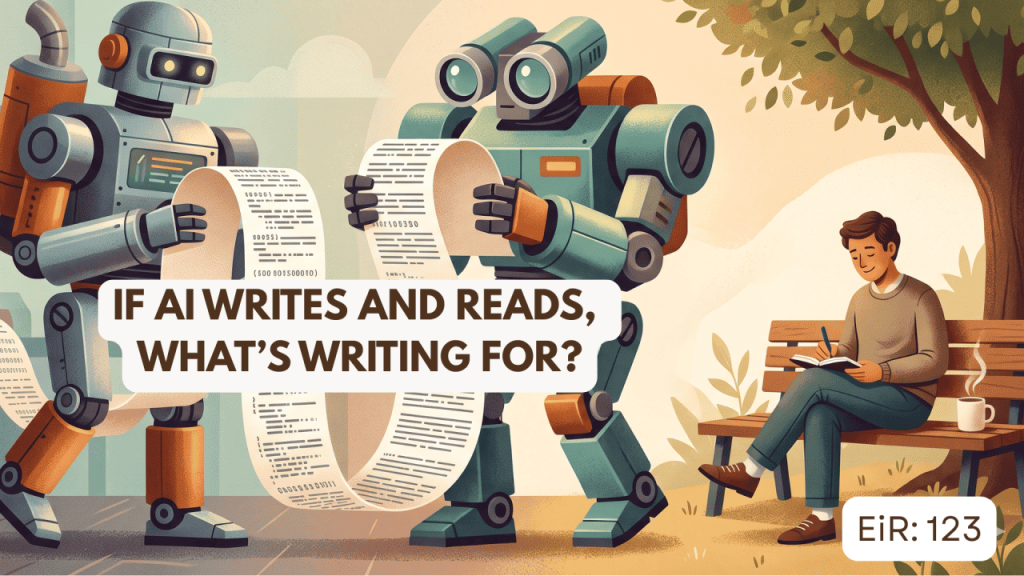
Lately I keep running into 3,000 to 5,000-word pieces. I wondered if the authors thought humans have that long an attention span. Until it occurred to me that they probably didn’t write for humans at all. Given the prose is neat and clean, but nothing compelling, they were in all likelihood written for AI agents.
For his second book on AI, titled, AI, titled: Co-existence: The Next Phase of AI, Wharton professor Ethan Mollick’s book site even has a section addressed to agents. This decision isn’t futuristic, it’s purely functional. I know of a few marketing consultants who have dedicated AI agents for select tasks. A consultant has a chief-of-staff agent for each client; the agent’s core job is to apprise him about what’s new at the client’s. If this consultant were to evaluate whether a new book on AI is worth his time, it’s highly likely he’ll rely on his agent’s assessment.
Strange world. AI both assists writing content from the creator side, and helps read content from the readers’ end.
Most professional writing seems headed that way. Workflows are being created to harness AI’s power best. And there’ll be a human in the loop responsible for how it works.
But with professional writing ceded to the AI, we might find out what human writing was for all along.
The data is already visible
Tim Ferriss recently shared a sobering look at his own book sales. His catalog of bestsellers, which had been a dependable annuity for years, fell about 46% in print in 2025, and 2026 is running at an even steeper pace. Industry data points the same way: self-help was the hardest-hit category in the first quarter of 2026.
His explanation: a how-to book is a lookup table. It answers “how do I fix my sleep?” or “how do I lose fat?” In 2019 a book was the best interface for those answers. Today a chatbot gives you a personalized version in seconds. Anything whose main job is moving instructions from one head to another is now competing with an instant, conversational alternative.
That adversely affects prescriptive nonfiction as a mass-market information business.
Writing was never just about delivering information
Paul Graham made this point best: some kinds of thinking can only happen through writing. When you try to put an idea into words, you find out you didn’t understand it as well as you thought. The mind that finishes the essay is not the mind that started it.
If writing is how we think, then outsourcing it means outsourcing the thinking. As Graham says, anyone who can’t write will be at a disadvantage on complicated, ill-defined problems. Exactly the problems AI can’t solve as easily (relative to well-defined problems).
Indeed, German philosopher Arthur Schopenhauer said: “The intellectual attainments of a man who thinks for himself resemble a fine painting, where the light and shade are correct, the tone sustained, the colour perfectly harmonised; it is true to life. On the other hand, the intellectual attainments of the mere man of learning are like a large palette, full of all sorts of colours, which at most are systematically arranged, but devoid of harmony, connection and meaning.”
Where human writing goes from here
Fiction. Fiction was always about the struggle to make sense of the messy human self, and readers connect with the writer through shared effort and vulnerability. George Saunders talks about helping writers find their “iconic space,” the place from which they can write the stories only they could write. Questions like “how should we live?” and “what should we value?” don’t yield to templates.
Writing for yourself. Many of us write to understand, not to inform. Author Anil Ananthaswamy says he doesn’t use AI to write because that would undercut the very reason he became a writer: the experience of finding precise words for his thoughts. Yet he is fine using AI for images, which aren’t his craft. Most of us feel this way about the work that means something to us, and we resist handing that part to a machine.
Voice and transformation over information. Ferriss says he would rather write for 10,000 people who are changed by his work than for millions who forget it within a day. Information is collapsing into the chatbot. Transformation, spending long stretches with one mind on a subject it has truly wrestled with, may get smaller, but it won’t disappear.
What’s left for us to write?
If your writing exists mainly to transfer information, expect AI to compete and even win. If your writing exists to think, to understand yourself, or to say something only you could say, AI is a bystander.
The future of writing is human because only the parts we write to understand ourselves, and to understand ourselves through each other’s writing will probably stay in the human realm.
What about you: do you write to inform, or to think? Has your answer changed in the last two years?


Leave a Reply