Last week, Anthropic created ripples by announcing that Claude-generated content would carry an invisible watermark. Every model launched after August 2, 2026 carries it: undetectable to a reader, embedded in the low-stakes word choices AI makes hundreds of times per response. That survives copy-paste, though not a heavy rewrite.
The EU AI Act triggered this. The reaction on X and Reddit has been mixed, several users publicly cancelling subscriptions calling it a betrayal of paying customers. Some copywriters were jubilant; this marked the return of human writers, they said.
So will this bring human writers back into demand?
My reading: no.
At most, it revives an entire cottage industry of tools that “humanize” AI text. These already exist. Anthropic’s own move just handed them a sharper use case and a bigger addressable market.
What the watermark actually does is more modest than either the outrage or the relief suggests. It doesn’t degrade quality. It doesn’t stop you from using AI. It just leaves a forensic trace, one that a full rewrite erases. Anthropic concedes it’s fair to ask whether the text can even be called AI-generated. The moment you’ve truly made the words your own, the mark disappears.
It puts a small tax on pretending, nothing more. Ghostwriters passing off wholesale AI drafts as personal essays, students submitting unedited output, thought-leadership posts with zero human fingerprints on them, these get marginally riskier to fake. Not impossible. Just less easy. Which is almost poetic. Tells you where things are headed.
Two Sides of the Same Coin
So if the watermark isn’t really the story, what is? It’s how it exposes how differently we feel about AI writing depending on which side of the transaction we’re standing on. As writers, we love that a few prompts produce a full-length essay. As readers, we feel cheated the moment we suspect the same thing.
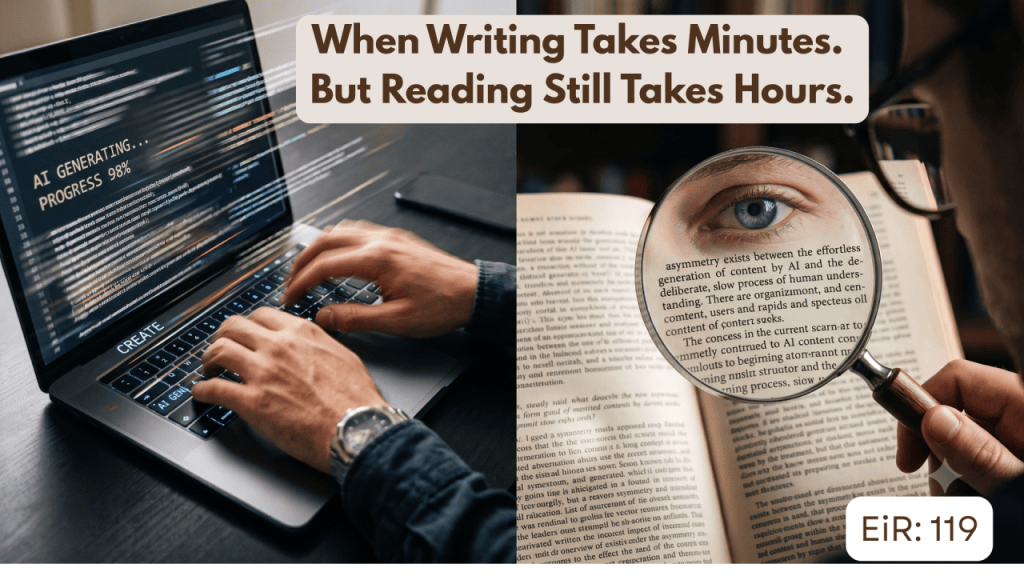
Why the asymmetry? For most of human history, it took longer to create text than to consume it. That imbalance wasn’t incidental, it was the point. The labor of finding the right word, structuring an argument, sitting with an unresolved thought until it resolved itself, that struggle is what a reader was implicitly paying for when they spent their own time reading.
AI severed that link. It now takes minutes to produce what takes hours to read. A reader I heard from recently put it better than I could: with food, we don’t mind that cooking takes hours and eating takes ten minutes, because the value was always in the consuming. With writing, the value was always partly in the making. When creation stops requiring effort but consumption still does, the imbalance removes the reason the exchange existed in the first place.
The Marketoonist cartoon nailed this a while back.

Two people, staring at screens, congratulating themselves on work neither of them actually did. That loop, AI writing for AI to read. And this is closer to our reality than we’d like to admit.
The Discipline Nobody Wants to Enforce
Clay, the CRM company, in their newly published internal AI writing policy didn’t argue that AI writing is dishonest. Rather, that writing is thinking, and if you let AI think for you, you understand your own subject less well. A status update or a project spec isn’t valuable as an artifact; it’s valuable as proof that someone actually thought the problem through. Skip that step, and you might walk away with a document, but not with understanding.
Their sharper point: more time should be spent authoring than consuming. If you generate a five-page document from a two-line prompt and ask five colleagues to read it, you’ve offloaded ten minutes of your effort onto hours of theirs. That’s not productivity. That’s cost-shifting dressed up as speed. As Clay puts it, readers can always talk to ChatGPT themselves if that’s genuinely what they wanted.
No amount of invisible signal in Claude’s token choices fixes a culture where everyone quietly agrees to skim what the other side didn’t really write.
What Actually Changes
Beyond that tax on pretending, the watermark might reduce the appetite for the 2,000-4,000 word article clearly written for an algorithm rather than a person. The kind stuffed with headers and keyword density; aimed at appeasing AI, not engaging humans.
But this won’t slow adoption. Businesses have tasted the volume and velocity AI enables, and we have reached a point of no return.
The problem is we haven’t built a shared etiquette about what’s fair to offload onto a machine and what still deserves the friction of human thought.
So, watermark or no watermark: the next time you write a 50 page report in 15 minutes, ask yourself: would you be happy to spend 2 hours on something that only took 15 minutes to write?
 Musings by Madhav
Leave a comment