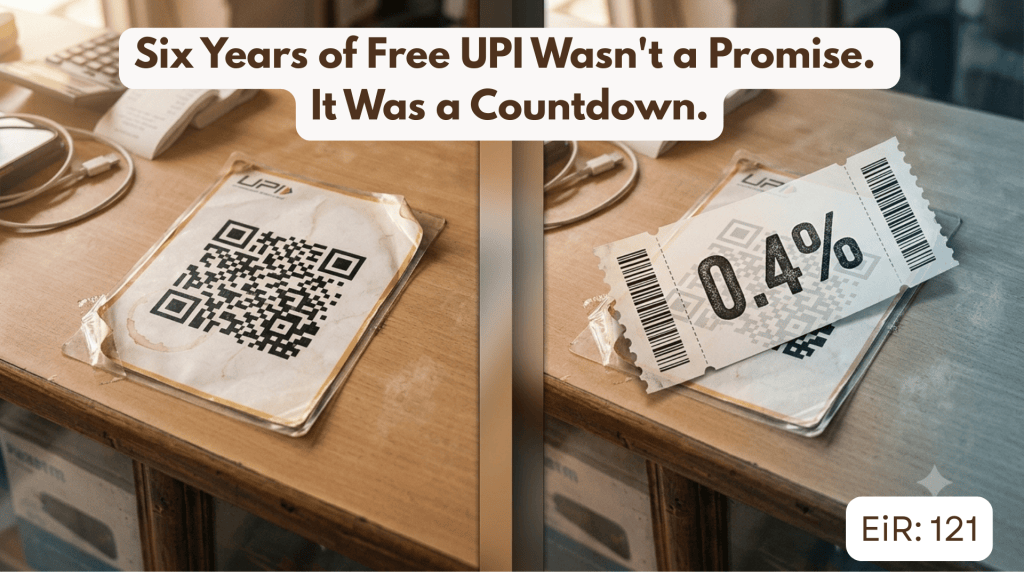
On October 15, India’s Unified Payments Interface will charge people for using it. NPCI has set a 0.4% Merchant Discount Rate on payments above ₹2,000, with a flat ₹5 fee for railways, telecom, insurance and fuel. Small merchants, under ₹1 lakh a month via QR code, stay exempt. Person-to-person transfers stay untouched.
The reaction was loud. The Retailers Association warned of a slide back to cash. Trade bodies call the timing, weeks before Diwali, reckless. Congress calls it a “digital payments tax.”
Significantly, they all treat the end of free UPI as the breaking of a promise. My point: it wasn’t one.
The subsidy was never meant to be forever
The 2017 Cabinet decision was clear: the government would reimburse banks’ MDR for a defined two-year period, and a committee would study the industry’s real cost structure. This time-bound adoption subsidy itself puts “UPI forever free” to rest. Commercial banks put the end-to-end cost of a transaction at ₹1–3. So the fact is someone was always paying it. Public policy just decided, for a while, that the exchequer would.
With spectacular results. UPI now processes over 24,000 crore transactions a year worth roughly ₹314 lakh crore, used by 55 crore people; close to 85% of India’s digital transaction volume. Since it’s no longer an infant-industry, continued subsidy needs stronger justification.
Insisting on zero MDR after the adoption burgeoned isn’t protecting growth.
Free-forever means underinvestment, not abundance
A network that earns nothing per transaction has no incentive to fund fraud prevention or resilience. As Anupam Manur of the Takshashila Institution has documented, banks and payment providers need an estimated ₹10,000 crore a year to maintain and grow UPI’s infrastructure; the government allocated ₹1,500 crore in FY25, a number that’s been falling. His accounting of the fallout: six major outages last year, one lasting five hours, and fraud losses past ₹1,000 crore annually and rising. That’s what underfunded infrastructure costs.
Today, PhonePe and Google Pay control 83% of UPI volume. Zero-MDR is one plausible contributor. Because it’s hard to fund the security and reliability a challenger needs to compete when there’s no per-transaction revenue to fund it with. Of course, it shares the stage with network effects, deep-pocketed parents, and years of marketing.
But Manur’s diagnosis is that subsidy is still a large part of why a third player never got the runway: a policy sold as democratising payments has instead entrenched a duopoly.
The public policy expert Pranay Kotasthane alignment principle names the underlying failure: services run best when there’s overlap between who benefits, who decides, and who pays. Indefinite zero-MDR breaks that on purpose. His sharper point: positive externalities justify a subsidy sized to the spillover at the margin, not a blanket forever-exemption.
India doesn’t make every vaccine dose free forever; it charges user fees on water and transit despite their obvious social spillovers. If UPI’s externality was digitizing the economy, that case was strongest years ago: when adoption was in doubt. Today, the case for continued free use is at its weakest. As Manur argues: UPI now clears more daily transactions than Visa.
And per Kotasthane, it increasingly behaves like a congested good, throttled at peak hours, rather than a textbook public good.
UPI is useful. It isn’t untouchable
Part of what makes “keep it free forever” sticky is that UPI is a uniquely Indian miracle the world hasn’t matched. That’s overstated. Europe’s SEPA Instant Credit Transfer, the UK’s Faster Payments, and various US tap-to-pay systems move money just as seamlessly, nearly all on some version of a merchant fee. Brazil’s Pix, UPI’s closest cousin, already charges merchants and works fine.
What UPI pioneered is the protocol: a common, interoperable rail any bank or app can plug into. That deserves protection, even subsidy. That every transaction riding on it must stay free forever is a separate and weaker claim.
Legitimate ≠ well-decided
Journalist Srikanth Lakshmanan‘s reporting adds a new angle to the fee debate. The Payments and Settlement Systems Act predates UPI. The 2026 amendment moves the power to license payment systems out of RBI’s sole hands into a board where government and RBI both sit.
That’s one independent regulator sharing the table with the government of the day, a stakeholder with its own fiscal and political interest in how UPI is priced.
When Facebook’s Free Basics tried to split the internet into free and paid tiers in 2016, over a million emails to TRAI forced an open consultation and the practice was eventually banned. This time, a consequential pricing decision for a shared utility has moved with far less scrutiny.
That the fee is defensible doesn’t make the process defensible.
Where the pushback is valid
Retailers are right that thin-margin merchants may simply revert to cash rather than absorb friction. India’s experience with MDR on credit-linked UPI already shows some merchants exit a rail entirely rather than pay anything, regardless of how the number compares to card rates. Cash isn’t free either: printing, distribution, and handling cost something. So the comparison is total system cost, not “free UPI vs. paid UPI.” And Lakshmanan’s governance point stands: a board of banks and payment firms pricing infrastructure that 55 crore people depend on, with merchants and consumers absent from the table, is a legitimate objection on its own.
None of that settles whether 0.4%, this threshold, this timing, this exemption structure, is calibrated correctly. Just that some price above zero is defensible.
The design tries to shield the everyday case: the ₹2,000 threshold, the small-merchant exemption, the ban on passing MDR to consumers. Whether it shields enough is a separate argument from whether it should exist at all. Conflating the two is how both sides end up talking past each other.
Zero was never a natural state for a service that costs money to run. It was a policy choice that shaped six years of investment decisions. Now that UPI has done what the subsidy is supposed to do, it behooves explanation as to why removing it took this long.
This piece draws on analysis from Anupam Manur (Takshashila Institution), Pranay Kotasthane (Takshashila Institution), and Srikanth Lakshmanan (DecodeInternet), credited where their arguments are used.


Leave a Reply