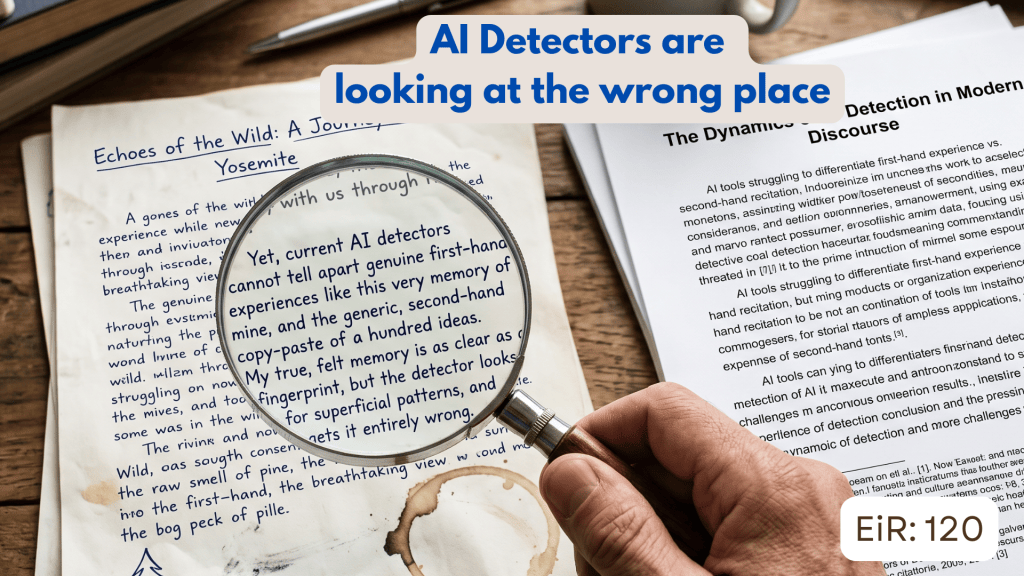
Last week, I fed Claude four of my own essays and asked it to estimate the likelihood that each was AI-written or AI-assisted.
- Two free-flowing personal essays, the reflective kind that made Medium popular a decade ago: one on Nietzsche’s amor fati and the trap of perpetual deferral, another on the quiet erosion of old friendships. (Essay 1, Essay 2)
- Two analytical essays: The other two were my own analysis of AI’s impact on writing and work, each supplemented by external validation: a real research paper, an expert’s argument, a specific citation. (Essay 3, Essay 4)
I expected the personal essays to score better. Surely lived experience reads as more human.
But Claude rated the reflective essays as more likely AI-assisted. The AI-analysis pieces, the ones leaning on Sutton’s Bitter Lesson and a University of Maryland paper on AI fiction, it read as more original and substantially human.
What Tripped the Wire
I asked it to explain itself. It offered six reasons: prose polish, structural scaffolding, citation depth, argumentative tension, hedging language, and personal anecdote specificity.
I went through these one by one.
- Prose polish and structural scaffolding: They prove little. Someone who drafts the bones themselves and then asks AI to act as an editor would produce this very signature.
- Hedging language, I pointed out, is a genre decision. In marketing writing, you write with conviction. Hedging is a liability. In reportage, it’s intellectual honesty. Say “my reasoning is largely anecdotal” in a whitepaper-adjacent essay and you sound careful. In a personal essay, hedging would make you look unsure of your own experience.
- That left two things standing: citation depth, and personal anecdote specificity.
So it narrowed to this:
Does one essay show more original thinking than the other?
Does the specificity of a personal story tell you anything real about the writer’s actual process?
Why is this a problem?
This reminded me of an old interview of Ramgopal Varma, the popular film director in India.
In this interview, Varma traces the genesis of his movie Rangeela: a friend who was a kind of street gunda was besotted with a girl well above his social station. He once wore brand new Nike shoes only to end up looking ridiculous doing it. Then one day he learned she was seeing some other rich guy. The director and others goaded him to beat this new guy. But the gunda friend welled up and said the lady deserved better than him; she deserved the rich guy.
The plot is nothing new and has been told many times.
But none of that touches whether Varma’s route to the story was genuine.
The objective familiarity of the plot and the subjective authenticity of how he arrived at it are two different questions.
You could read a plot summary of Rangeela next to any knockoff and can’t tell which episode came from the real story and which came from flipping through old films.
This is the trap Claude had walked into.
My two AI-analysis essays scored as “more original” because Sutton’s Bitter Lesson and a named research paper are objectively less-worn material than Nietzsche’s eternal recurrence or Kahneman’s two selves. But staleness of citation says nothing about freshness of encounter. I might have stumbled onto that Nietzsche line for the first time on the exact evening.
That the idea was common currency doesn’t mean my observation was secondhand.
And a research paper being obscure doesn’t automatically mean I read it with more investment than I felt reading Nietzsche. Just like Rangeela’s plot being unoriginal doesn’t make Varma’s friend any less real.
What Claude Actually Conceded
When I pushed on this, the answer I got back was honest.
Every remaining signal, Claude admitted, dissolves into one of two explanations. Either it’s a genre convention that predates AI. (It overlaps with how AI happens to write now, trained on decades of exactly this kind of prose). Or it’s confounded by a writer’s own subjective process, something invisible to a reader.
It confessed it no longer had a defensible method for inferring AI involvement from the texts alone. Its own words: it could describe stylistic patterns, but couldn’t convert that into a probability.
All because it couldn’t resolve the one thing that would settle the question: what happened at the moment those words were produced.
Where This Leaves Detection
We’re trying to reverse-engineer intent, effort, and originality from the shape of the sentence.
But AI cannot tell you whether it wrote the piece, restructured a rough draft, or simply tidied a sentence. From the style, AI can’t distinguish a writer’s real Rangeela moment from someone else’s borrowed template, because both outputs look the same.
Setting aside detection, a better question is whether the writing earned its conviction. Not something you can infer from a sentence. You’d have to have been there, the way Varma was there, the night his friend cried and said she deserved someone better.


Leave a Reply