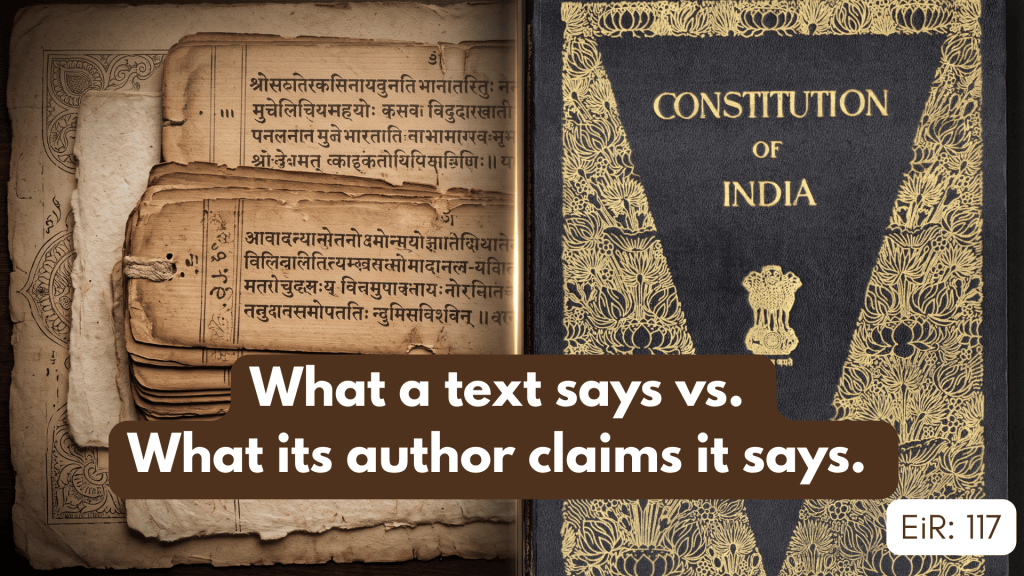
Can you tell what a text means without ever asking what its author meant?
While writing about The Dark Knight, I expressed surprise that its director Christopher Nolan thought the film’s dominant theme is escalation, that each side’s actions provoke a worse response from the other. Because most critics (and even I) read it differently: we thought the film was about the thin line between good and bad. About how “you either die a hero or you live long enough to see yourself become the villain”.
Same film. Two readings.
The work an author thinks he’s made isn’t always the work that exists on the page or the screen. So,how do you ever pin down what a text is actually saying, independent of what its author claims?
I didn’t have a good answer then. Until a Hindu scholar introduced me to an analytical lens built for exactly this problem.
A method with no author to ask
At Ramakrishna Math, Halasuru, in a casual conversation with a Hindu scholar, I learned about a 2,000-year-old framework to solve this. Shad Linga is a six-marker method the Mimamsa tradition developed to settle what a Vedic text’s purport was.
It’s suited to this problem in a specific way: the Vedas have no single author to interview. They were composed by many hands across centuries. So the tradition had no choice but to build a method that reads the text as a self-contained object: its opening, its recurring themes, its outcomes, its internal machinery. Significantly, it never asks who wrote it or why.
It asks the text six questions, and only the text:
- Upakrama-Upasamhara — does the ending keep faith with the opening?
- Abhyasa — does the same idea keep recurring, or show up once and vanish?
- Apurvata — what does the text supply that nothing before it could?
- Phala — what outcome is the text’s own logic aimed at?
- Arthavada — what do the explanatory passages reveal, even where they’re not enforceable?
- Upapatti — what machinery converts the intent into something that actually works?
No debates or drafting notes. No author even. Just architecture.
Why the Constitution was the right test
That the Constitution of India is a social revolution document is close to settled history at this point, thanks in large part to Granville Austin’s The Indian Constitution: Cornerstone of a Nation. The book argues from the Constituent Assembly debates, Ambedkar’s and Nehru’s own words that the framers set out to engineer a social revolution, not just transfer power from colonizer to citizen.
That’s an intent-based answer and it comes from what the authors said they were doing.
So I had a genuine test on my hands: take a method that is structurally blind to everything Austin used (the speeches, the memoranda, the floor votes) and see if it lands on the same word anyway, using nothing but the text itself.
→ Upakrama-Upasamhara: the Preamble’s promise of justice and equality survives seventy years of amendment — Article 334 stretched repeatedly for SC/ST, then EWS and women; the Ninth Schedule absorbing land-reform law into the 1990s.
→ Abhyasa: equality recurs at every altitude — Part III’s abolition of untouchability, Part IV’s welfare directives, Part IVA’s duty to renounce practices demeaning women, reserved seats in Panchayats, an entire Part built around protections for excluded groups.
→ Apurvata: Article 17 broke with millennia of custom in a single line. Universal adult suffrage with no property or literacy test was a genuinely bold bet for a country of India’s scale in 1950. Article 31B’s shield for land reform against judicial review went further than most constitutions of that period.
→ Phala: the text’s own logic aims at converting a feudal order into one of equality and dignity — not merely a change of rulers.
→ Arthavada: the Preamble and the Fundamental Duties supply the framing the Supreme Court itself leaned on in Kesavananda Bharati.
→ Upapatti: Articles 15(4) and 16(4) reconcile reservation with formal equality; Article 32 , Ambedkar’s own “heart and soul” of the Constitution, makes rights enforceable rather than merely declared; Article 368’s amendment procedure lets the project keep moving.
Six markers. One word: revolution. Reached without once asking what Ambedkar intended.
What this is actually evidence of
A caveat: I applied Shad Linga to confirm if the arc of the constitution bent towards social revolution. If my experiment was not primed to this end, other conclusions are possible too.
But what it does show is that a method with no access to authorial intent reproduced the same reading that decades of archival, intent-based scholarship arrived at. Here, the text and stated intent agree.
Compare that to Dark Knight where they don’t. Same setup — an intent-based reading vs. a text-based one — different result.
The finding: whether a work’s architecture and its author’s stated purpose line up isn’t guaranteed either way. Sometimes they diverge (Dark Knight). Sometimes they don’t (the Constitution).
This has huge implications for how we audit strategy and policy today.
The open question
What makes a text hold together with its author’s stated intent, and what makes it come apart?
Is it something about legal and constitutional texts specifically, built with the amendment process, courts, and successive legislatures as much a part of the “text” as the words themselves? Or does it show up just as often in fiction, once you look for it?
I’m curious: if you work in constitutional law, hermeneutics, or systems thinking, have you run into clear cases where the “text” contradicted the “intent”? Let’s discuss in the comments.


Leave a Reply