When do you realise you’re closer to middle age than to youth? Theories abound. The mirror is your most faithful ally. Impossibly young colleagues at work run a close second. But to me, the most conclusive proof is simpler: the near-total absence of friends in your daily life.
Memory isn’t kind to you at this stage. A conversation with a friend you thought happened six months ago actually happened three years back. And what did that conversation contain? The same endless loop, replayed on WhatsApp.
"Hi — what's up?" "Same, same. How about you?" "Been long. We should meet soon." "Yes yes, let's plan."
Silence for six months. Rinse. Repeat.
Meanwhile, I remember nothing about their actual lives. How many kids? Where are they working? The latter question is redundant, their LinkedIn profile tells me more than they ever would. It’s more an icebreaker for a conversation that has nothing left to break the ice for.
Two Selves, One Friendship
Daniel Kahneman drew a useful distinction between our two selves: the experiencing self, which lives entirely in the present moment, and the remembering self, the storyteller who retrieves memories and assigns them meaning.
When I think about my old friendships, I realise my remembering self has been doing all the heavy lifting. It recalls the intensity of those college-day bonds vividly: the closeness, the shared references, the ease. But the experiencing self, the one that would answer honestly if asked “does this friendship feel alive right now?”, lives in a very different reality: one of perfunctory check-ins and group-chat silences.
We don’t choose between friendships. We choose between memories of friendships.
And memory, being generous by nature, makes it healthier than it actually is.
Proximity, Not Just Depth, Sustains Friendship
I moved to a different city about a decade ago, away from where most of my post-graduate network still lives. In the early years, I pestered people, sent reminders, forced meetings into existence. Today, my messages announcing a visit often go unacknowledged.
There’s exactly one friend I’ve been able to meet consistently. Because he lives half a kilometre away. Because meeting him costs him nothing. The irony: we weren’t particularly close in college. But today, I probably know more about him than I do about my closest friends.
This is also why colleagues feel closer than old friends: not because the bond is deeper, but because daily proximity brings the transaction cost of maintaining it down to near zero.
You don’t need to schedule a coffee with someone you already pass in the corridor. The moment people change jobs or cities, that proximity disappears, and the relationship gradually reverts to an occasional LinkedIn like.
Friendships are born through shared values. But they are sustained through shared geography, and once that geography is gone, everything runs on marginal cost. A phone call, a message that goes beyond “what’s up”, showing up even when it’s inconvenient, all of it is cheap in isolation. But so is skipping it, in any single week. Nothing breaks if you don’t call or meet. A neglected friendship gives you no immediate signal of loss. There’s no dramatic falling out. Three years pass on and you wake up to find you’re now strangers who happen to share a few old memories.
It’s the same reason 80% of people abandon their New Year resolutions by mid-January: not one catastrophic failure, but enough inconsequential single days piling up into total abandonment.
There’s another culprit: the illusion of abundance. We once had limited access to our friends: a landline call was an event, a letter took days, a visit had to be planned weeks in advance. Each interaction carried weight precisely because it was scarce. Now, with infinite channels available at any hour, the urgency to actually use any one of them quietly dissolves. Friendship, once rationed by distance and cost, has suffered the same fate. We have so many ways to reach each other that we rarely bother reaching at all.
The Invisible Grief
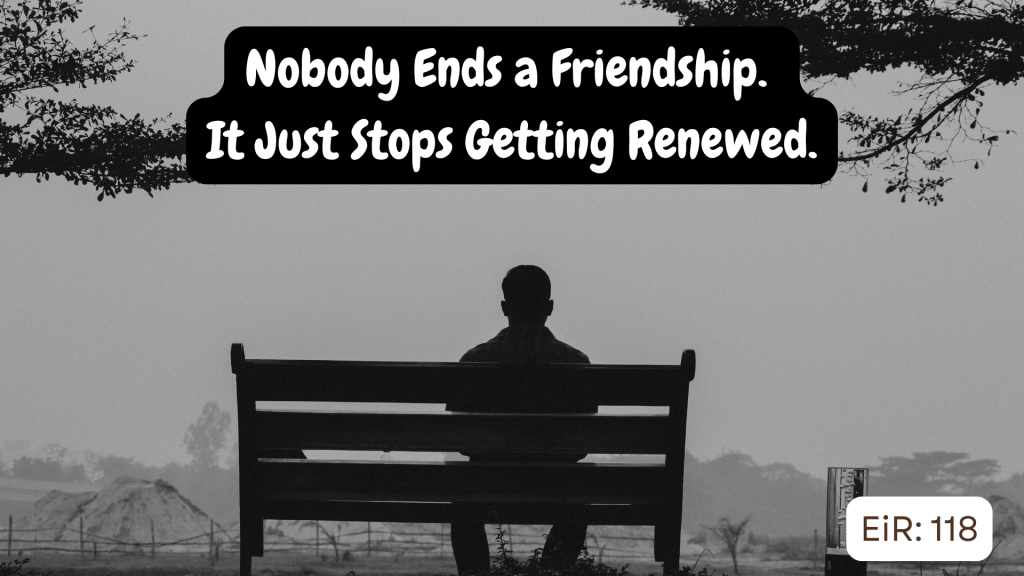
The erosion is imperceptible by design. These friendships don’t end in a dramatic scene: no fallout, no final argument. They simply dissolve through postponed calls and missed meetings. And because nothing dramatic happened, we don’t register it as a loss, only in hindsight.
Most of us built our adult lives optimising for career, city, salary, commute. We assumed friendship would survive neglect the way a tenacious weed might. But friendship, like a delicate plant, demands investment, and neglect damages it. Just that here, the results are visible only years later.
Blind Consistency Is Not Loyalty
A lot of what passes for maintaining friendship is a habit dressed up as loyalty.
In my school WhatsApp group, a friend suddenly left without any message. A discussion followed on whether to invite him back. I argued against it. The person, I argued, is probably unable to relate to a group he last shared a physical room with decades ago. Forcing him back would be fabricating continuity where none exists anymore. Worse, it would be disrespectful to everyone who chose, deliberately, to remain.
I’ve done the same myself. Thrice, on a different group, my messages proposing a meet-up went unacknowledged. Stunned by the silence, I left. Not out of bitterness, but out of the realisation that staying was inertia, not connection. Some of these groups persist purely on the low friction of doing nothing: leaving requires an action; staying requires none.
Acceptance Is the Final Stage of Grief
“I’m busy” is one of the most tone-deaf things we can say to explain away unavailability. Because everyone is busy. We’re all simply busy with different priorities, and priorities are just another word for what we’ve chosen over what (or whom) we haven’t.
If someone consistently doesn’t return your calls, you are, to put it gently, not on their priority list right now. I say this with respect, to them and, more importantly, to yourself. When met with sustained indifference, you owe yourself the dignity of gently disengaging rather than performing a friendship that exists only on paper.
This is the zen of it, really: not resignation, but acceptance.
Accepting that this isn’t changing in a hurry. People too busy for you today will likely be just as busy for the next fifteen or twenty years. Nothing about their situation is going to auto-correct itself. And you’re better served letting go than nursing quiet resentment like an unrequited lover.
So What Can We Actually Do?
Redirect that energy toward new hobbies and communities built around shared interests. This might sound almost transactional. But that’s precisely how our closest friendships began too, before nostalgia rewrote their origin story. Nobody sits down on day one and swears eternal loyalty; people simply keep showing up around a shared interest until proximity turns into intimacy.
The goal isn’t to find someone to pour your heart out to. It’s simply to have small talk with people who share your wavelength, in a room you’re actually likely to be in again next week.
That is enough. It was always enough. We just forgot, somewhere between adolescence and adulthood, that this is how it starts every single time.


Leave a Reply