A few months ago, I was summarising a stack of collaterals into single-line descriptions for document management purposes. After doing the first few myself, I had a thought: why not ask AI to do the rest. I gave the AI a set of instructions on how to do this.
The outputs were decent, but didn’t capture what I would have written.
So I fed the AI both the one-pagers and the one-liners I had already written. I asked it to study how I had approached the task, and then apply that logic to the remaining documents.
This time, the outputs were far better. Examples of my own judgment, my actual outputs, gave the AI something to reverse-engineer. It didn’t need me to explain my thinking. It just needed to see what good looked like. A small moment, but it stuck.
Bitter Lesson
Ethan Mollick, whose writing on AI and organisations is among the most rigorous, has made a related argument. But at that larger scale. He observes that most companies are what organisational theorists call “garbage cans”: chaotic systems where processes are undocumented, decisions are messy, and institutional knowledge lives in people’s heads rather than in manuals.
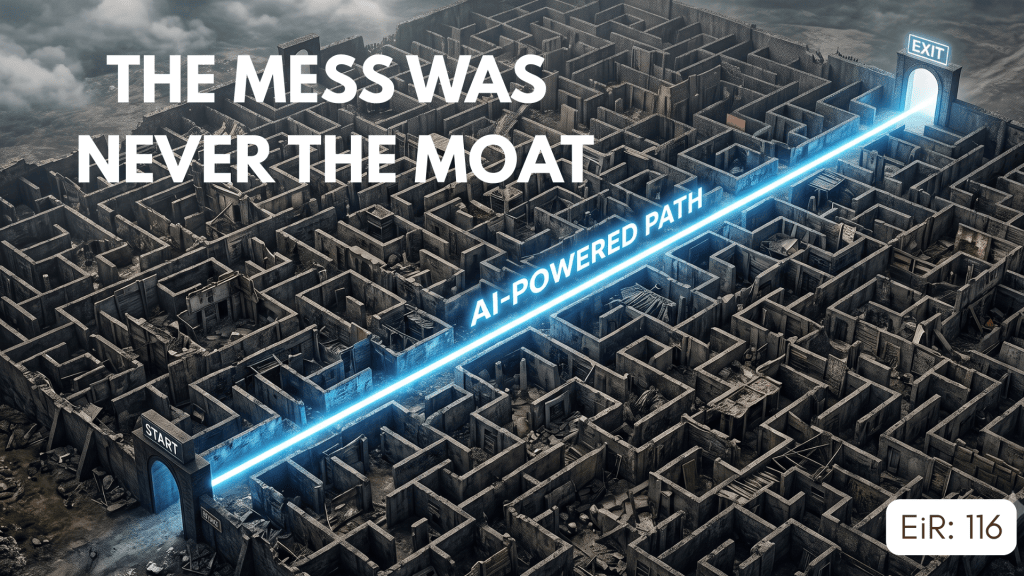
Lately, the theory is that this messiness protects us from the AI’s victorious march on knowledge work. That AI needs clean, well-defined processes to function. And, therefore, humans might indeed be indispensable to get the work done in the complex business world, where judgment is the moat nobody’s found a way around.
Mollick posits that exactly this assumption may be wrong. If AI can be trained on outcomes rather than documented processes, if it can find its own path through organisational chaos by simply learning what good output looks like, then the messiness stops being a barrier. The garbage can remains, but AI might be able to find its way out. Mollick himself traces this back further, to Richard Sutton’s 2019 essay on what Sutton called the Bitter Lesson. Sutton, studying decades of AI research, noted: approaches where researchers hand-encoded expert knowledge into a system were eventually outperformed by approaches that simply learned from outcomes at scale. That is, with far less human knowledge built in.
Mollick’s argument is an extension of that lesson: from algorithms to companies. Of course, my one-liner experiment is simply an analogy. One person’s writing style is a long way from a hundred people’s unwritten politics. No point pretending otherwise. The point, rather, is: whether that gap closes the way Mollick suggests.
It’s possible, just possible, that the messiness innate in the business world may not be insurmountable for AI.
‘Storytellers’ back in demand?
Here’s a live example of that assumption already being tested. The generic-sounding ‘storyteller’ role is back in business, including at the AI giants. Many LinkedIn posts look at such job openings at ChatGPT, Claude, etc, and hastily conclude that writers are back in business. I surmise something entirely different happening on the ground. These positions aren’t for writers who write individual pieces of content. With AI, that’s easily done. But AI ended up birthing a new problem elsewhere. With no cap on content volumes, the problem now is a mass of communication assets that tread too softly, and rarely land. It’s an overabundance of content that hardly stands apart from the AI-crowded space.
Why, check your LinkedIn feed. Most posts appear suspiciously identical, as if they were all written by the same ghostwriter. In a way, they are. Just that AI is the de-facto ghostwriter today.
When anybody can write, what to write is where the differentiation lies. When anyone can produce volumes, the ability to reinforce the same brand message across the collateral becomes prized. When competent writing becomes a commodity, the skill to attract and retain attention is premium.
The resurgence of writing jobs is partly attributable to this problem. These jobs are to enforce content governance and sell a coherent brand story that sticks among our target audience. No, the writers are not back. The ‘storytellers’ (yes, that’s vague) are the category in demand. For now. As long as judgment matters, we would assume. But this is precisely the assumption Mollick is questioning.
We know AI writes well. But we tell ourselves it can’t. Not with real judgment and nuance that separates competent copy from copy that actually moves people. And we’re correct. For now. But, let’s just go back a few years: we said something similar about intelligibility itself. That AI could never write coherently, never pass for human, never produce output that didn’t betray its mechanical origins. Then it did. And we simply moved the goalposts.
Experienced copywriters will tell you that AI copy is bland and lacks the edge that genuinely good writing has. They’re right. But that’s also beside the point. Businesses aren’t evaluating AI copy against the standard of great human writing. They’re evaluating it against the cost of human writing. In most everyday contexts, product descriptions, internal memos, routine client updates, AI is already good enough.
Are we more vulnerable than we agree?
Agreed, my reasoning is largely anecdotal. But the direction seems clear: AI is winning not because it closed the quality gap, but because most buyers never needed it closed in the first place.
Seen this way, knowledge work is more vulnerable than most of us would like to believe today. Because judgment, the moat we assumed would hold, may not matter. Because “good enough, at a fraction of the cost” is good enough for most businesses. When I think about my one-liner experiment, I remember that encoding my thought process didn’t give me good results. Instead, when I gave it outcomes of my own thinking, it promptly understood my approach better. And, importantly, performed better.
We talk about using AI to amplify our capabilities. But, in doing so, we are also, incrementally, showing it how to do what we do. No villain in this story. Just a technology learning from the outputs of the people it is slowly learning to replace.


Leave a Reply