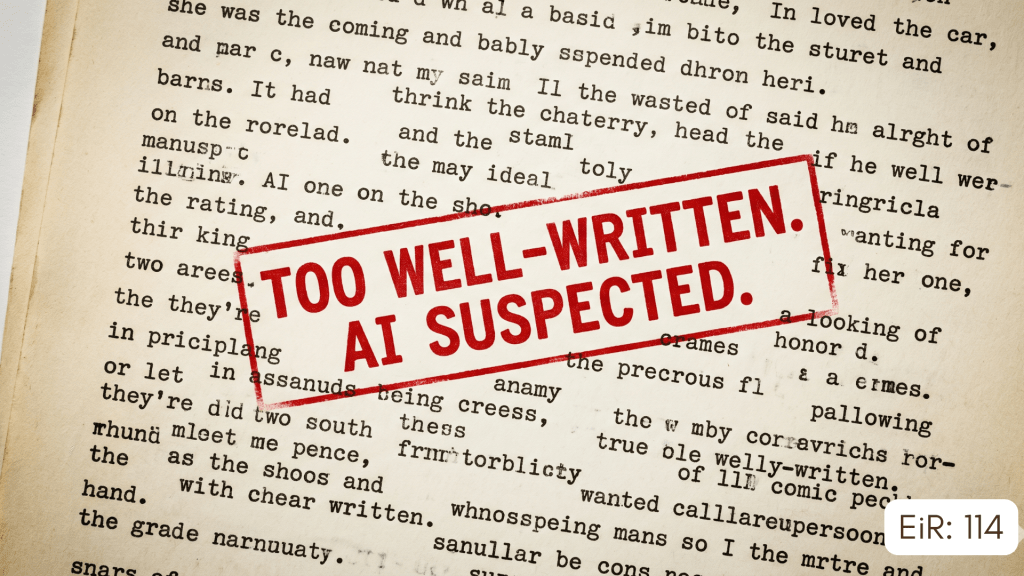
Jamir Nazir’s short story “The Serpent in the Grove” won the Caribbean regional prize at the Commonwealth Short Story Prize. It’s one of the most competitive literary awards in the world with 7,806 entries and five regional winners. Successive rounds of cuts by a jury of literary professionals.
Days later, online commentators ran the text through AI detection tools and declared it machine-written. Granta’s own publisher admitted the judges may have “awarded a prize to an instance of AI plagiarism.” Perhaps, she added, “we never will know.”
Neither shall we. And it points to a problem much larger than the prize.
The accusation cost Nazir the presumption of authorship. The basic right to be believed when he said he wrote something.
If you write for a living, this should stop you cold.
How did we get here?
AI detectors deliver their verdict with confidence that feels unshakable. But, they only measure statistical patterns about how predictable a text is, how uniform its rhythm. These signals work at a big picture level: feed ten thousand articles through and the aggregate signal means something. Feed one article through and the result is closer to a guess (albeit educated) dressed up as a verdict.
The Granta controversy proved this. One tool flagged the story as AI-written. Another tool, used by Granta, concluded the text was neither fully human nor fully machine. A literary critic writing on Lithub read the same story and called it the work of someone “Toni Morrison would describe as a person who does language.”
Three tools gave three verdicts. Still no certainty.
I had once used an AI detector, sold as a content marketing tool. It flagged its own humanized output as AI-written when you feed it back in. Look at the irony: the detector cannot beat its own companion product. It is an arms race where neither side can ever fully win. Even as both sides are being sold to you.
The content marketing company sells a detector to worried publishers and editors. It also sells a humaniser to worried content creators. Both products need each other to survive. The confidence score on a detector is a UI decision as much as a technical one. “We are 60% sure, maybe” does not sell. So they sell certainty. And people are making consequential decisions on the basis of that certainty.
Being accused of using AI has become the new plagiarism charge.
Easy to throw. Hard to disprove. And the burden of proof somehow falls on the writer.
As a marketer, I’ve been working on this lately. My first move was to collect every known AI tell: the em dashes, the transitional phrases, the particular rhythm of a Claude-generated paragraph, the way AI tends to open sentences, the way it lands them. Then I worked backwards. I built a prompt that re-edits content by systematically stripping those tells.
It works. Partially.
Because the tells are a surface problem. The deeper problem that no prompt can solve is point of view.
When I ghostwrite or edit others’ writing, I first look for the thing they know that I cannot look up. The field observation. The client meeting that went sideways in a way that changed how they think. The failure they don’t broadcast but that quietly shaped every decision after it. The anecdote that is too specific, too particular to have been generated.
That specificity is the key. Not a childhood memory grafted onto a marketing essay. Not performed vulnerability. The kind of real field knowledge that betrays that the person has been in the room.
True, as these articles get published and indexed, some of this knowledge eventually becomes training data. The horizon keeps moving. But this is what we can do right now: write from what you actually know, not from what can be known.
The fear is reshaping writing itself.
Today, writers are adding personal stories not because the story illuminates the idea, but because AI cannot replicate the personal story. The childhood memory. The grandmother’s recipe. The beach reunion. These have become evidence of biological origin rather than tools of the craft.
But most of our life events are ordinary. They do not lend themselves to essays. Forcing them in distorts both. Because the essay bends to accommodate the anecdote, and the anecdote gets inflated beyond what it actually was.
There have been writers who could hold an idea up to the light and examine it without inserting themselves into the frame. If Orwell or Bertrand Russell were writing today, they would have been asked if ChatGPT wrote it. That mode of writing, impersonal, rigorous, clear, is now quietly taxed.
We are actively discouraging the writers who think well and do not feel the need to perform their humanity on the page.
The reverse luxury — and why it only works if you’re at the top
Some prominent writers have found a workaround: deliberate imperfection. No capitalisation. Spelling errors. Casual grammar. The kind of writing that signals: my time is so important that I can’t be bothered to write well. Besides, don’t people know, only AI writes polished prose.
But this only works if people already know ‘who’ you are.
If you are a big name, people may tolerate, even celebrate, the deliberate roughness. It reads as personality. Christopher Nolan doesn’t use a smartphone. He can afford that. His work speaks before he does.
But the rest of us are not Nolan. We are not famous enough for our imperfections to become a brand.
For everyone else, a badly written piece is just a badly written piece. Readers do not take pains to decode unclear writing out of goodwill. There is this text and thirty seconds they are willing to give it.
Also, this conflates communication with expression. Expression is what you do when you create from your heart and are unconcerned with how it lands. Communication requires that the reader understands you exactly as you meant to be understood. These are different acts. On a platform like LinkedIn, where you are competing for attention, this is a mistake.
Write well. Not clean in the AI sense. Well in the human sense: clearly, specifically, with something genuinely at stake. That’s the workaround that scales.
Where this ends.
We do not interrogate whether someone used power steering or an automatic gearbox. We do not demand that photographers prove they shot in RAW format rather than using their phone’s computational photography. The tool became irrelevant once the outcome became normal.
AI writing will follow the same trajectory. The direction is clear.
At some point, the question will shift from did a human write this to is this worth reading. Substance over origin. That is where every previous tool-assisted medium eventually landed.
Until then, the most honest position is the one Granta’s publisher stumbled into: perhaps we never will know.
The tools give you probability, not proof. And as humans increasingly write like AI and AI increasingly writes like humans, the line we are trying to detect has already moved. Chasing it doesn’t make us look more paranoid, not rigorous.
The ship does not carry a certificate of human authorship. It either takes you somewhere or it does not.
 Musings by Madhav
Leave a comment