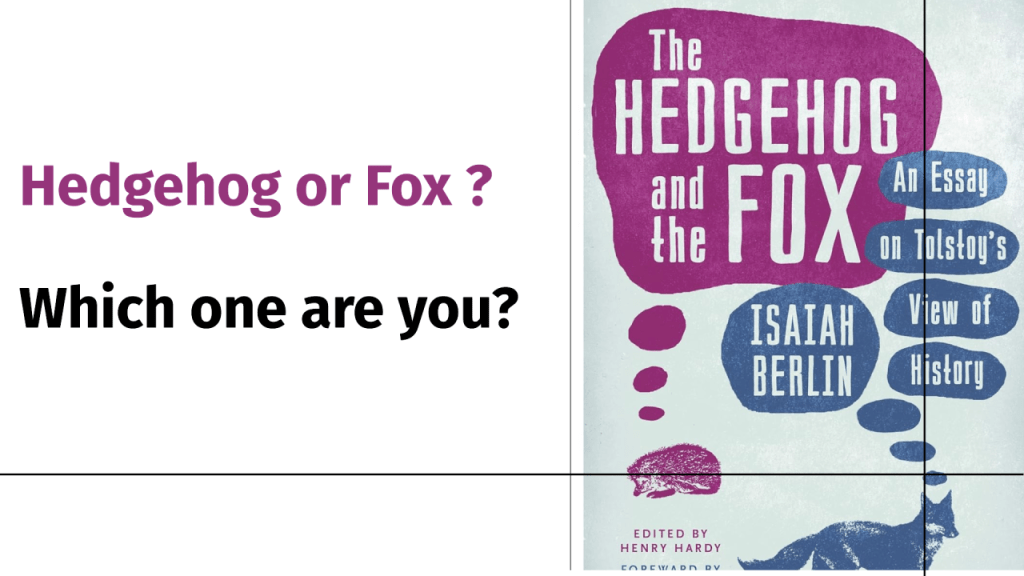
“The fox knows many things, but the hedgehog knows one big thing.” ~ Greek poet Archilochus
Many thinkers interpreted this in different ways. However, Oxford philosopher Isaiah Berlin used it to analyze Russian writer Leo Tolstoy’s philosophy and his view of history.
Berlin uses the metaphors to place humans into two categories:
- Foxes who are interested in many things
- Hedgehogs who align everything they see with their central, all-encompassing vision.
Berlin writes: “There exists a great chasm between those, on one side, who relate everything to a single central vision, one system, less or more coherent or articulate, in terms of which they understand, think and feel—a single, universal, organizing principle in terms of which alone all that they are and say has significance.”
Whereas, on the other hand, there are, “those who pursue many ends, often unrelated and even contradictory, connected, if at all, only in some de facto way, for some psychological or physiological cause, related to no moral or esthetic principle.”
Who’s Who
In Berlin’s view, Tolstoy is actually a fox who desired to be a hedgehog.
Among the foxes, he mentions Shakespeare, Goethe, Aristotle, Heraclitus, Montaigne, Erasmus, Pushkin, Balzac, Joyce.
Their canvas was massive. Their expertise extensive.
And he classifies the following people as hedgehogs: Dante, Plato, Pascal, Hegel, Nietzsche, Ibsen, Proust, Dostoevsky, Henry James.
These are known for espousing a highly specific point of view. To the extent that the essence of their writings can be distilled in a few pages. To borrow a cultural phrase, they are the “melting pot”.
Foxes are comfortable with contradictions. He can hold diametrically opposite perspectives when the subject-matter shifts. In the cultural parlance, they are the “fruit salad”.
By this logic, I think Karl Marx should be ranked a first-rate hedgehog. His philosophy attempted to reduce every subject, particularly economics, to the class struggle. To his mind, his theory explained all the complexities in the world.
In contrast, Will Durant consciously took a fox-like approach to the study of history and philosophy. He tried be neutral and understanding of the ways of people who lived long before his time.
He once remarked: “Most history is guessing, and the rest is prejudice.” That didn’t prevent him from undertaking the highly ambitious task of summarizing “The Story of Civilization” in 11-volumes. As foxy as it goes.
Which One Is Better?
The case for being a fox seems obvious. Nonetheless, being a hedgehog has its attractions.
Their capacity to simplify things helps hedgehogs stand out from the crowd. Their ability to see and present things from their unique lens attracts attention.
In my experience, hedgehogs are primed for the extremes of success and failure. The ability that catapults them to success also pushes them to failure. By wearing ideological blinkers, they can’t see things that don’t align with their theory.
To put it in Sherlock Holmes’ words: “It is a capital mistake to theorize before one has data. Insensibly one begins to twist facts to suit theories, instead of theories to suit facts.”
In contrast, foxes are better able to adapt to changing circumstances, and adopt different strategies for different contexts. However, lack of unifying vision can show up in unlikely places.
Leaders that quickly digest a new piece of information into their worldview radiate confidence. But leaders who can only accommodate, not digest, new information, while they appear more humane, lack charisma.
Rethinking the Metaphors For Organizations
Let’s apply the lens for organizations.
What’s more permanent about an organization?
- People? They move in and out.
- Offices? They change all the time.
- Products? They change too, based on customer preferences.
What’s the more enduring feature of an organization: they have a single, central, all-embracing vision.
However rigid, this has its advantages over the fox approach.
The modern business landscape is in a constant flux. Organizations pursuing every fad might scatter their focus and slow their progress. For their efforts to yield tangible results, they need to be stubbornly consistent about their vision. Such a vision allows them the luxury of overlooking temporary trends and dips, and instead aim long-term. They don’t have to continuously re-evaluate their business focus against the constant onslaught of complex information.
The lure of such luxury is not to be discounted.
Conclusion
German philosopher Arthur Schopenhauer thought his works adequately solved all the problems of philosophy. He even considered getting his signet ring carved with an image of Sphinx falling down the abyss (the myth says she promised to do so if her riddles are all answered).
However, as Schopenhauer’s biggest admirer, and also his intellectual heir, Friedrich Nietzsche declares: “There are no facts, only interpretations”.
It’s alluring, even seductive, to entertain the thought of one theory that explains it all. To my mind, it’s not always possible to tie up disparate elements into a common thread. It’s okay to be comfortable with contradictions.
Hedgehogs, at their best, may be transformational leaders. But the downside is equally extreme: they can turn into dogmatic fanatics. At least in this score, foxes are better; they may be humans struggling with contradictions, i.e. simply humans.


Leave a Reply