“We’re going to see more and more billion-dollar businesses built by four or five people.”
When Naval Ravikant made this prediction in 2012, it seemed audacious. Today? It feels normal.
We’re seeing smaller teams and solo operators building what once required entire departments. A developer who once needed software testers, research assistants, graphic designers, marketing strategists, GTM specialists, and content writers can now rely on AI to serve as that entire junior team.
This is rewriting the fundamental rules of career survival.
The Specialist’s Dilemma
For decades, the settled career wisdom was to pick a lane, master it, and become valuable. In an age of information scarcity, when insider knowledge was privileged and entry barriers to new skills were significant, specialization made sense.
But AI has shattered many of those barriers.
Consider the marketing specialist who spent years mastering Facebook Ads. Today, AI can set up, optimize, and report on campaigns faster than any human. The content strategist who built their career on editorial calendars? AI now plans, writes, and schedules content across multiple platforms simultaneously.
The ability to synthesize, not retrieve knowledge, is the edge today.
While AI meaningfully boosts productivity, it’s also dismantling the entry barriers atop which we’ve built our professional lives.
The Renaissance Mindset Returns
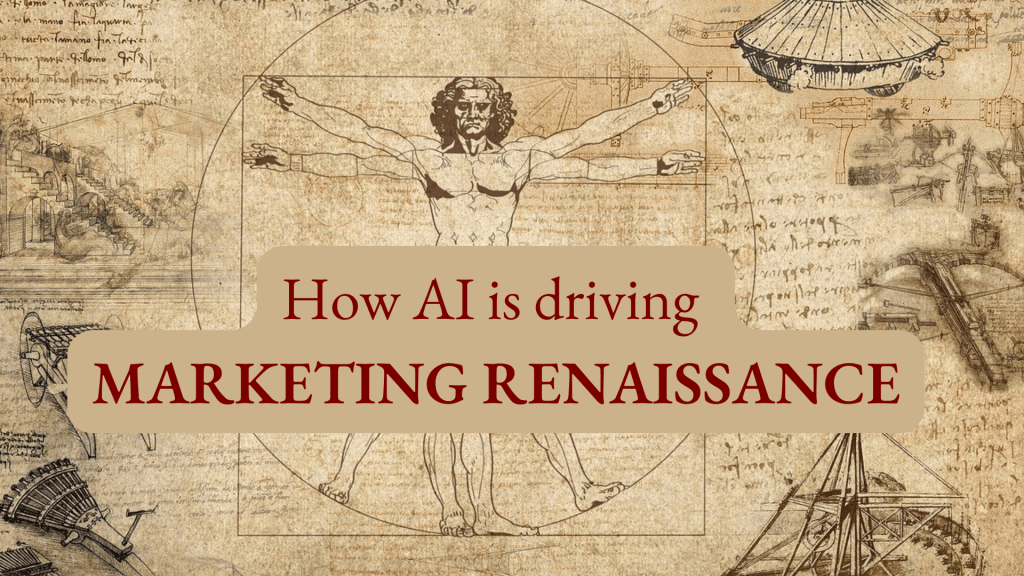
Consider Leonardo da Vinci: a polymath who could effortlessly switch between painting, engineering, anatomy, architecture, botany, mathematics, and theatre design.
This Renaissance approach to knowledge is experiencing a digital revival. We’re seeing this pattern emerge across industries. Professionals pursue multiple interests, refusing to choose between them, and find ways to combine domains that were previously siloed.
While AI can write code, create graphics, and analyze data, it struggles to connect the dots across domains. This synthesis between unrelated domains remains uniquely human. And this could best improve our employability in an AI-saturated world.
What Machines Can’t Synthesize
AI can promptly generate hundreds of pages of content.
But as Stuart Winter-Tear, an expert on AI product strategy, explains: “Machines can recall and remix. They struggle to weigh trade-offs, hold contradictions, and ask what we’ve failed to notice. Strategists stitch signals into a coherent plan: market truth, product reality, timing, channels, metrics, and the internal politics that decide whether anything ships.”
He asserts you can’t prompt your way into certain things like, “How to read a stakeholder. When to push a spiky POV and when to bank trust. How to turn a founder’s hunch into something the market can hear.”
While admitting that AI excels at the task layer, he cautions: pairing AI with strategist gets you leverage. Replacing the strategist with “more content” gets you noise.
The human element still drives commercial success.
Indeed, he concludes: “AI generates. Strategists decide. The edge is judgment in context.”
The Product Strategist’s Revelation
Praveen Gopal Krishnan’s recent decision to move from Chief Operating Officer back to Chief Product Officer at The Ken best illuminates this shift. He reasons that in a world where anyone can build anything, the people who decide what to build become exponentially more powerful.
“AI isn’t killing these functions,” he observes, “it’s simply clearing the field.”
This same trend is reshaping marketing. When anyone can produce content at scale, strategy becomes the ultimate differentiator. When everyone can analyze data in real-time, synthesis becomes sacred. When AI can execute campaigns flawlessly, the ability to determine which campaigns deserve to exist separates the strategists from the executors.
Soon, leaders faced with endless possibilities will seek those who know what’s truly worth creating.
The Agency Imperative
The power balance is shifting dramatically from institutions to individuals with initiative. Traditional advantages like formal education, certifications, and years of domain-specific training, are eroding as AI tools perform tasks that once required extensive expertise.
What matters now? Agency. Not a marketing agency. But the agency that marketers used to and need to possess.
The willingness to act, synthesize, and build.
Speed and execution have become critical. Generalists who can quickly synthesize insights from multiple areas can outpace specialists who excel in singular domains, as AI compresses years of execution into days or weeks.
Today, your competitive advantage comes from your ability to connect the dots across domains and act on those connections with conviction.
The Generalist’s Calculated Risk
For marketing professionals, this shift presents both opportunity and concern. Yes, becoming a generalist carries risks. A “jack of all trades, master of none” is more vulnerable to replacement by younger talent.
But AI now provides the execution layer for domains adjacent to your core expertise. This facilitates the evolution of a T-shaped marketer. Someone who possesses expert-level competency in 2-3 core areas while using AI to competently operate in related domains.
This T-shaped skill profile is specialized enough to be valuable and broad enough to maneuver towards adjacent marketing skills when required.
You become the human interface between AI capabilities and business outcomes.
The marketing generalist doesn’t replace depth with breadth. Instead, they use AI to maintain operational competence across multiple domains while deepening their strategic thinking about how those domains interconnect.
The Entrepreneurial Employee
What’s the most AI-proof skill today? The ability to think like an owner within any organizational structure. Not necessarily abandoning corporate roles for solo ventures. But bringing an entrepreneurial mindset to your work.
The entrepreneurial employee doesn’t just execute campaigns; they ensure those campaigns serve broader business goals. They don’t just analyze data; they synthesize insights that inform product roadmaps. They don’t just create content; they shape the narrative that positions the entire company.
These employees will become indispensable not because of what they know, but because of how they think.
The Future Belongs to Synthesizers
David Samuels, literary editor of Tablet, warns that “platforms animated by machine logic turn people into functional subroutines.” If we start thinking like machines, how can we stay ahead of them?
By refusing to think like a subroutine. By refusing to separate your interests into neat, AI-optimizable categories. By refusing the false choice between specialization and generalization.
This is the marketing generalist’s moment! It arrived not despite AI, but because of it. When machines can execute flawlessly across multiple domains, the humans who can strategically direct that execution become significantly more valuable.
The future belongs to those who can:
- Synthesize insights across domains that AI treats as separate
- Make strategic decisions about what deserves to be built
- Connect human truths with technological capabilities
- Move with agency and conviction within their organizations
- Create work that feels distinctly, authentically human
Between striving to outwit AI in areas where it’s indisputably superior and leveraging AI to do something irreplaceably human, what will you choose?
Choose synthesis. Choose to think like an owner. Choose to be the strategist in a world drowning in AI-generated tactics.
The specialists may build tomorrow’s tools. The generalists will determine what we build with them.


Leave a Reply