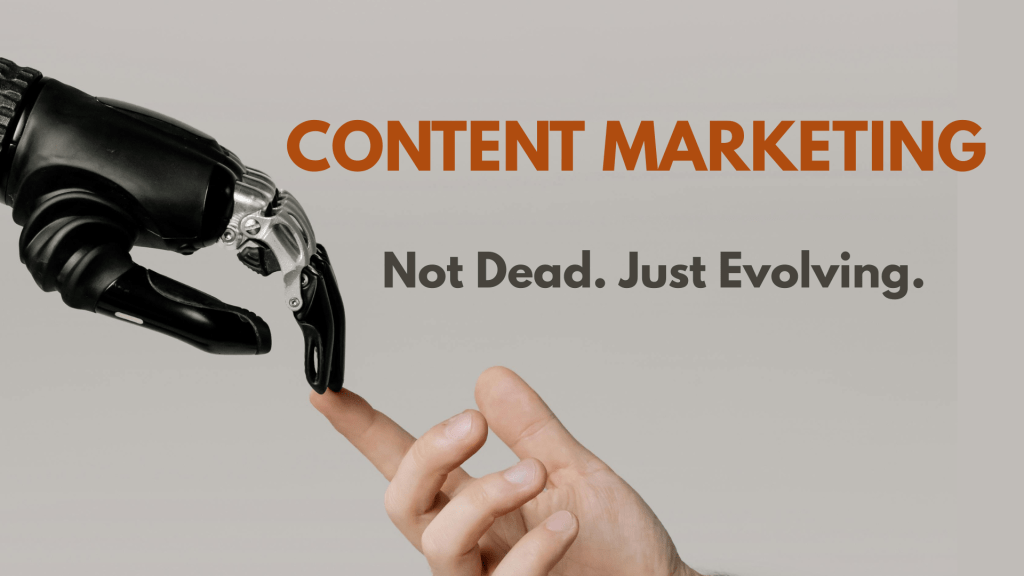
If I received a dollar each time I read that human writers are obsolete because ChatGPT has consumed content jobs, I’d be several thousand dollars richer today. Yet here’s a delicious irony that should give us pause: OpenAI, the very company supposedly eating content jobs, recently posted this job description:
"We're looking for a Content Strategist to define and execute our content strategy. This role is critical in creating high-impact content that drives awareness, top-of-funnel traffic, and product adoption. You'll shape how our brand sounds to the world, set the voice and tone guidelines, and roll up your sleeves to write, edit, and publish content that resonates with a global audience."
The company poised to eliminate content marketers… needs content marketers. If that’s not a signal worth examining, what is?
The Peak of Inflated Expectations
We’re currently experiencing what Gartner calls the “Peak of Inflated Expectations” in their AI hype cycle. While AI meaningfully boosts productivity (and I won’t dispute that) the rhetoric around human obsolescence far exceeds the on-ground reality.
Consider this: as AI saturates digital spaces with manufactured content, human oversight may well become the defining value proposition. Consumers are growing increasingly disillusioned with the sheer volume of online content, including rampant misinformation. Gartner predicts that by 2028, 70% of marketing budgets may pivot back to offline channels, a direct consequence of collective digital detox.
When artificial output floods every channel, the premium on authentic, human-crafted interaction will only rise.
The Authenticity Crisis Looming Ahead
Here’s where it gets unsettling: AI has been feeding on human-authored content to learn. But we’re approaching an inflection point where AI will increasingly feed on AI-authored content.
This creates a feedback loop. Generic insights feeding on generic insights. Stale thinking recycling stale thinking.
In a world where anyone can generate 1,000 words on any topic in minutes, who’s doing the thinking that actually changes minds?
As authenticity and original thinking become scarce, they offer companies the competitive edge.
Good Writing Changes People’s Minds
Larry McEnerney, Director of the University of Chicago’s Writing Program, offers a brilliant insight: “You think professional writing is conveying your ideas to your readers. It is not. Writing is changing their ideas.”
Good content doesn’t just explain things to your audience. It changes your readers’ perception, moving them from “I understand” to “I understand, and as a result of this understanding, I am thinking differently now”.
Can AI change minds? Or does it simply rearrange existing information into different patterns? The evidence suggests the latter. AI excels at synthesis and presentation. But it struggles with the kind of original insight that shifts perspective.
The Goodhart’s Law Trap
There’s a cautionary tale here about metrics obsession. Goodhart’s Law states: when a measure becomes a target, it ceases to be a good measure.
Consider Medium. When it launched, writers loved their easy-to-use interface, authentic content, and community. It all went well until marketers found that Medium posts rank well in Google. That changed the game. Soon, the authentic, original, and offbeat writing, the ones that provoke us, was sidelined by generic, stale and SEO-friendly content. Today, I see variants of “10 ways to..” around every conceivable topic.
When you incentivize something, you end up getting more of it. Medium optimized for visibility, and marketers capitalized on it. As a result, (and this is a personal experience), I feel less drawn to Medium lately.
The lesson: every time we chase the metric instead of the mission, we risk being co-opted for the machine’s purposes rather than our own.
The Revenue Obsession Paradox
Lately, it’s become fashionable to insist that every marketing effort must be directly revenue-driven. While marketing must indeed impact the bottom line, the obsession with direct, immediate returns can cause us to miss the bigger picture.
Marketing’s purpose isn’t just filling the pipeline. It’s making the entire sales process smoother by building the trust and credibility that makes selling effortless. When prospects already know your brand, believe in its value, and trust its efficacy, your sales team spends less time educating and more time closing.
When we reduce marketing to a single metric like pipeline contribution, we treat it as just another lead generation channel. This shortchanges marketing’s broader impact: influencing every interaction your prospects have with your brand.
Branding vs. Demand Gen is a false dilemma.
Both demand generation and branding must run in parallel. Startups that claim they don’t have the luxury of branding misunderstand what holistic marketing accomplishes. Marketing is shorthand for fame. Fame helps people decide, often before they even engage with your sales team.
What Smart CMOs Are Already Doing
The winners aren’t choosing between human creativity and AI efficiency. They’re combining them strategically:
- They use AI for productivity, not thinking. Research, first drafts, optimization? Yes. Strategic positioning, authentic voice, original insight? No.
- They invest in uniquely human capabilities. Critical thinking about industry dynamics. Customer empathy that comes from real conversations. The ability to challenge conventional wisdom. These skills can’t be automated, and they’re becoming more valuable daily.
- They measure what actually matters. Not just content volume or immediate clicks, but audience engagement depth, brand perception shifts, and long-term relationship building.
- They’ve built hybrid workflows. AI handles the heavy lifting; humans handle the heavy thinking.
The Human Premium in an AI-Saturated World
Here’s the contrarian bet: as AI democratizes content creation, it simultaneously increases the value of human insight, strategic thinking, and authentic voice. The future doesn’t belong to those who can generate more content faster. It belongs to those who can think differently, challenge assumptions, and create genuine connections.
Content marketing isn’t dying. It’s evolving from a volume game to a value game. The question isn’t whether we need human content marketers. Of course, we do. The real question is whether we’re developing the uniquely human skills that AI can’t replicate.
The companies doubling down on authentic human insight while leveraging AI as a productivity tool will separate themselves from those chasing the latest content automation trend. In a world of infinite artificial content, finite human creativity becomes infinitely more valuable.
With due apologies to Mark Twain (who was misquoted on the original too), “Reports of Content Marketer’s death are greatly exaggerated”.
 Musings by Madhav
Leave a comment