The Writing Is the Easy Part Now
A writer friend of mine, who once tasted critical acclaim before slipping off the literary map, called me recently to ask whether AI had killed his career.
His sales had flatlined. He gestured at the Amazon charts, thick with clean, readable, aggressively optimistic titles. “Is it the algorithm? Is it AI?”
Yes, I told him. But only partly.
AI has done something specific to writing: it has made correct prose a commodity. When writing was hard, it was a signal of effort. That signal has collapsed.
But AI didn’t create the deeper problem. It accelerated one already in motion.
The Medium Was Already the Problem
Years ago, I tried to convert a 45-minute webinar into a blog post. I was convinced the material would yield four or five pages of rich content. It barely filled two.
That episode helped me understand, viscerally, what Neil Postman meant when he argued that a particular medium can only sustain a particular level of ideas — that “oral, literate, and televisual cultures radically differ in the processing and prioritization of information.”
Writing, Postman believed, was where complicated truths lived. It freezes speech, he said, and in doing so “gives birth to the grammarian, the logician, the rhetorician… all those who must hold language before them so that they can see what it means, where it errs, and where it is leading.”
What happens when the written medium is colonized by the logic of television? When the algorithm, not the editor, decides what survives.
We are no longer just amusing ourselves to death. We are now expected to amuse others while we write.
Two Jobs, One Title
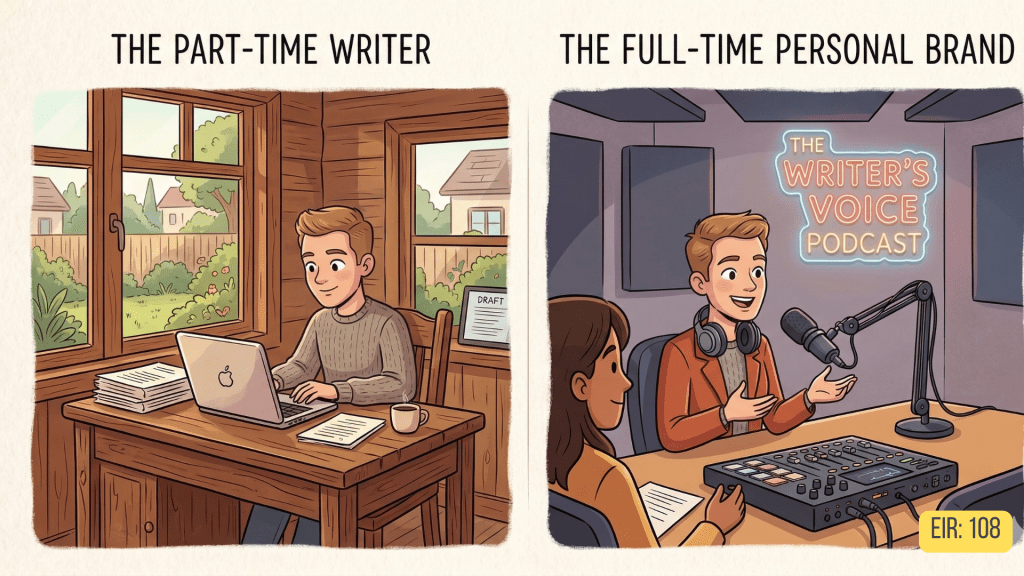
The job of being a writer has quietly become two jobs. Most writers only signed up for one.
Deep writing requires sitting with a problem long enough to see its full shape. You resist the urge to resolve the mess too quickly. You wait for the thing to reveal itself.
Algorithms reward showing up. Constantly.
The writers I watch carefully today all operate on the same rhythm: daily posts, regular podcast appearances, the same core thesis repeated on rotation until it calcifies into a brand. Rob Henderson, who built 180K followers over five years, is direct about why: repetition is the only way to break through, because even your most loyal readers will miss most of what you put out.
So you write something you’re genuinely proud of. Only to spend three weeks slicing it into tweets so that the people who follow you might actually encounter it.
The Podcast Loop and What It Costs
Most podcast appearances, even the rigorous, intellectual ones, are entertainment with educational trappings.
Even serious ideas must now be packaged as performance to survive. You need stories, opinions, a persona that carries well on a microphone.
You only need to hear a person two or three times to absorb their actual thesis. Everything after that is marketing. But the market demands the loop continue.
I have watched genuinely good thinkers hollow themselves out chasing the circuit — fighting a version of themselves that wants to double down on ideas they know land well over ideas they actually believe.
The performance, over time, starts to eat the substance.
What AI Cannot Steal
In a world where 74% of new webpages now contain AI-generated content, presence has become the last moat.
AI can mimic style. It cannot replicate the specific texture of someone who has lived through something, thought it through over years, and carries the residue of that in how they write. As they say: ChatGPT can never write deep literature, because it never had a troubled childhood.
This is precisely why “personal branding” has become every serious writer’s preoccupation. The face behind the text is now the value signal. The recognizable voice with its specific history.
Consider the implications. Online recipes now begin with the chef’s childhood because if they don’t, a bot will outcompete them with a million variations in thirty seconds. The same logic has migrated entirely to essays, newsletters, and books. If a writer doesn’t stake a claim on their specific personhood, they get absorbed into the undifferentiated flood.
The Quiet Writer’s Dilemma
The writers who suffer most from this are the ones who believed, reasonably, that the work should speak for itself.
Ironically, the writers capable of something genuinely worth reading are often the least suited to the promotional performance required to ensure readership.
Today, quality without visibility amounts to silence.
What 2026 Actually Looks Like
The actual writing is probably 20% of the job now. The rest is curation, presence, repetition, and what Henderson bluntly calls becoming a “mini-celebrity.”
Your information diet becomes a craft. Your platform becomes a compounding engine. You show up consistently — not necessarily because you always have something new to say, but because showing up is what keeps you legible to the algorithm and, by extension, to readers.
This is the new baseline.
The Problem is … Choice
Some writers are making the system serve something real. You test an idea as a tweet. Replies push it somewhere you hadn’t considered. It becomes a post. Then an essay. Then a chapter. The public iteration isn’t separate from the thinking — it is the thinking, done out loud.
But the danger is that the loop becomes the work.
Back to my friend: I didn’t have the heart to tell him that the odds aren’t in his favor. What I did tell him is that the answer wasn’t better writing — the writing was already good. The answer was deciding whether he was willing to be more visible, consistent, present.
Some writers will choose not to. But that choice should be made consciously, not in mounting confusion about why the world stopped discovering them.
We live in an age where writing is thinking on paper, but publishing is performing in public. The two have never been the same thing. Now, for the first time, the second one determines the fate of the first.
 Musings by Madhav
Leave a comment