In my very first newsletter, I quoted Scott Adams saying: “Systems > Goals.” That’s how deeply I internalized this particular insight.
I first encountered Scott Adams through the cubicle-dwelling cynicism of Dilbert. Office satire at its finest. Years later, I picked up his book, How to Fail at Almost Everything and Still Win Big, and his unconventional philosophy of success spoke to me.
With the news of his passing yesterday, I pondered over his final message: “I had an amazing life… If you got any benefits from my work, I’m asking that you pay it forward… Be useful.”
While the last decade of his life was indeed controversial, I believe that the artist as an artist ≠ the artist as a human being. We can judge the man, but we should not ignore the brilliance of the blueprints he left behind.
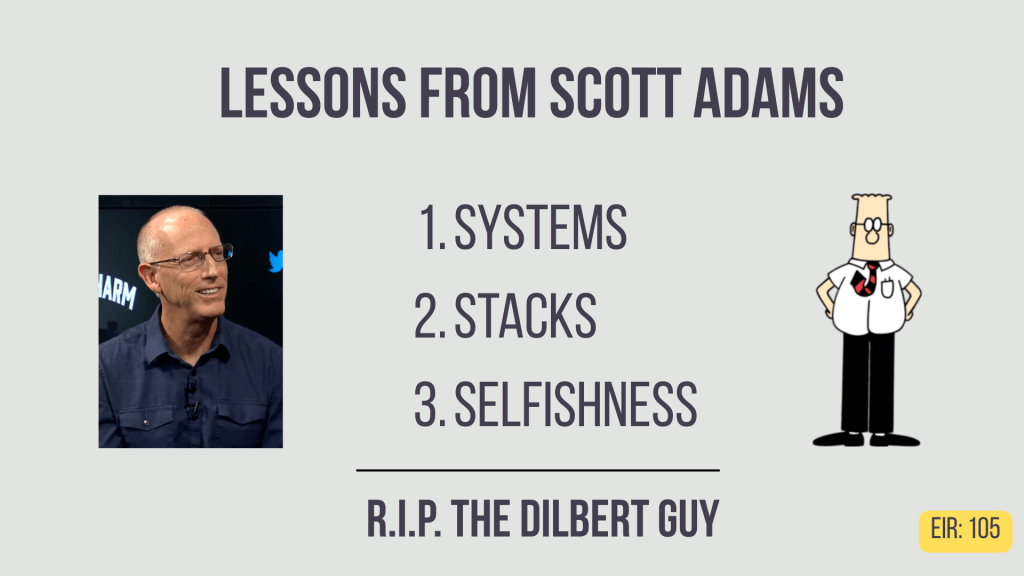
Here are my top 3 takeaways:
1. Systems > Goals
Adams famously wrote, “Goals are for losers. Systems are for winners.” He argues that a goal is a specific objective you either achieve or don’t, leaving you in a state of “continuous pre-success failure.” A system, however, is something you do every day that increases your odds of happiness in the long run.
In my 1st newsletter, I explained it thus:
“Aiming to finish a book in 2024 is a goal. Writing 1 hour each day is a system. Accomplishing a goal is subject to many external factors. Writing 1 hour every day, by comparison, is vastly within your control.”
This ties into his views on luck. You can’t control luck, but you can “manage” it by staying in the game. “Failure is your friend. It is the raw material of success.” If you stick with a system, you’re positioning yourself so that when luck eventually strikes, you have the net ready to catch it.
Systems keep you in the game long enough for the math of success to work in your favor.
2. Good + Good = Great
“Specialize.” That’s the advice we receive most. Adams suggests a different path: The Talent Stack.
“Successwise, you’re better off being merely good at two complementary skills than being excellent at one.”
This helped catalyze my decision to take up a course in public policy—a subject with no obvious benefits for a marketing writer. Alone, I was just another marketer. With a good grasp of public policy fundamentals, I have a voice that can withstand academic scrutiny while remaining persuasive. The rigor of policy makes my marketing claims both credible and persuasive.
As Adams noted, “Happiness has more to do with where you are heading than where you are.” When you keep stacking skills, you aren’t just learning; you’re heading toward a “unique niche of one.” In the age of AI, this matters even more. As I argued in Why AI Made Marketing Generalists Unstoppable, being “merely good” at a unique combination of skills is the ultimate job security. It’s how you move from mediocrity toward excellence.
3. Selfishness vs. Dependency
Perhaps his most misunderstood insight. But most useful all the same. The choice is not between being selfish vs. selfless. That comes later. In the beginning, the choice is between being selfish vs. being a burden on society.
He argued that you must prioritize your own health and career first, or you risk becoming a burden on the world. “Being a burden is the most selfish thing you can do.” By contrast, if you are self-sufficient, you are in a position to actually help.
All this ties into his final message: “Be useful.” Being useful is an understated virtue. It doesn’t require being extraordinary; it just requires an ordinary person self-sufficient enough to contribute back.
Closing Notes
Scott Adams taught me that you can fail at almost everything—as he did with various business ventures—and still “win small” (sometimes, you don’t win big just by reading a book claiming so 😜).
Nonetheless, I’m indebted to him for the wisdom and the humor, both delivered from a truly unique perspective on life.
Which of these resonates more with you? Let me know your thoughts in the comments.
#ScottAdams #SystemsThinking #TalentStack #CareerAdvice #Dilbert #PersonalGrowth
 Musings by Madhav
Leave a comment