“What if a demon were to creep after you one night… and say, ‘This life which you live must be lived by you once again and innumerable times more…’ Would you throw yourself down and gnash your teeth and curse that demon? Or would you answer, ‘Never have I heard anything more divine’?” – Friedrich Nietzsche
Recently, I caught myself muttering: “This is still prep for what’s to come. My best is yet to come.”
Just until my skill is recognized. Just until I have more money. Just until life announces itself.
A season of preparation before the real show began.
Then, staring at the person looking back at me in the mirror, I realized: the person I was waiting to become wasn’t stuck in traffic. He wasn’t coming. Because he was already here: brushing his teeth, scrolling through emails, struggling through everyday monotony.
The Pattern of Perpetual Deferral
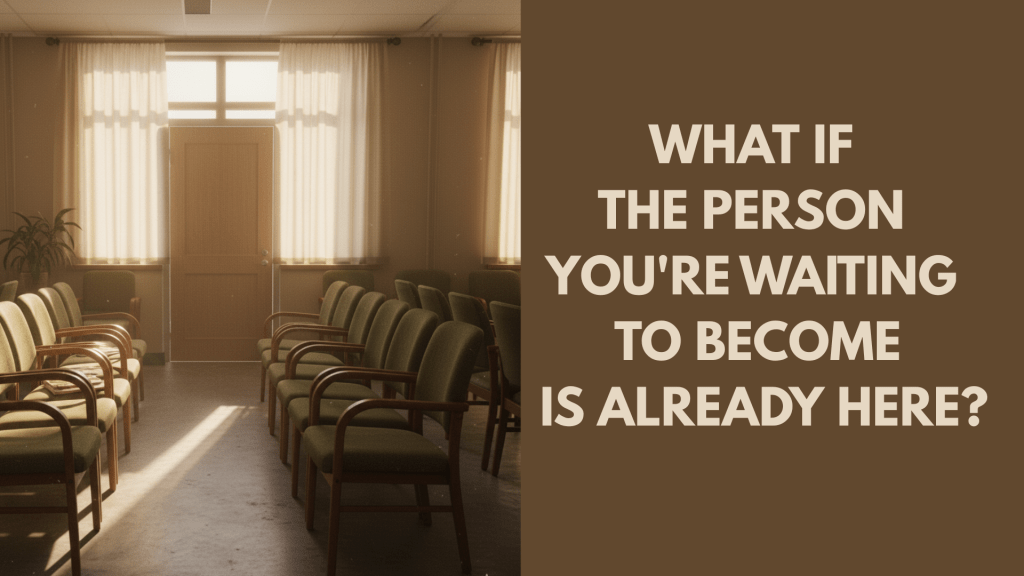
We treat the present like a waiting room. The future becomes a storage unit we’re too scared to open. What if it contains exactly what we already have?
We do this because a part of us refuses to accept ordinariness. We imagine our lives will warrant a feature film: obstacles overcome, recognition earned, the montage where everything clicks into place.
But life rarely announces itself that way.
Problems are at least dramatic. What wears you is the relentless sameness:
- Commuting through endless traffic
- Living within limited means
- The gap between what you imagined and what materialized
These aren’t cinematic. They barely register until they become your reality.
Hannah Arendt understood this. She wrote about “the daily fight in which the human body is engaged to keep the world clean and prevent its decay.” What makes the effort painful, she observed, “is not danger but its relentless repetition.”
The mundane Monday is where most of us fracture.
The Cost of Waiting
There’s a moment when you notice you’ve been living in the lobby.
It’s just the dull realization that you’ve treated years of your life as rough drafts; all hoping to produce a masterpiece one fine day.
Harvard professor Dan Gilbert calls this the “Impact Bias”: our tendency to overestimate how much future events will affect our happiness. His findings show that “if it happened over three months ago, with only a few exceptions, it has no impact whatsoever on your happiness.”
Your happiness would have remained at similar levels regardless of most paths you chose.
The promotion you didn’t get. The relationship that ended. Within three months, your baseline returns. So the belief that life would feel radically different once X happened was the miscalculation.
The Pixel Theory of Life
Tim Urban describes what he calls “the pixel theory” to explain why our lives feel so underwhelming day-to-day.
“Jack sees his life as a rich picture depicting an epic story… But this is a mistake, because Jack doesn’t live in the picture’s broad strokes, he lives at all times in a single pixel of the image—a single Today.”
“Jack’s error is brushing off his mundane Wednesday and focusing entirely on the big picture, when in fact the mundane Wednesday is the experience of his actual life.”
When you zoom out far enough, many of our lives are interesting. If you edited only the pivots and turning points, it would be cinema-worthy. But you don’t live in the edited version. You live in the pixels.
Each Tuesday. Each commute. Each ordinary conversation. This is not the preamble to your life. This is your life.
Amor Fati: The Lens We Need
Nietzsche had a phrase for this: amor fati—love of fate.
“My formula for greatness in a human being is amor fati: that one wants nothing to be different, not forward, not backward, not in all eternity. Not merely bear what is necessary, still less conceal it—all idealism is mendacity in the face of what is necessary—but love it.”
Far from settling, this is engaging with what is, rather than mourning for what isn’t.
The formula becomes:
Acceptance of uncertainty + Commitment to effort + Appreciation of the present = A sustainable approach to life
This won’t make next week easy. But it makes it bearable.
And bearable, when sustained long enough, eventually leads somewhere. Even if that somewhere is simply a life well-lived in ordinary circumstances with a clear conscience.
What Changed (And What Didn’t)
What’s different now? Nothing.
I still do the same work. I still sit in the same traffic. I still have weeks where nothing remarkable happens. And that’s the point.
The change is in the lens. I stopped asking, “When will my real life begin?” and started recognizing that it already had years ago while I was busy waiting.
I show up on boring Wednesdays the same way I did before. But I no longer treat these as a precursor to something big. They are the thing itself.
There was no breakthrough moment that transformed everything. Life doesn’t work like cinema, and that’s fine.
Because cinema compresses decades into two hours. But you and I? We live in all the hours that get cut from the final edit.
The Room We’re Already In
Your draft will never be perfect. There will always be a “just until” tempting you back into postponement.
Steve Jobs said: “You can’t connect the dots looking forward; you can only connect them looking backwards.”
So stay. Stay in the Tuesday that looks nothing like the fantasy. Stay in the commute. Stay in the everyday routine.
This is not a dress rehearsal. This is the take.
The sometimes joyous, sometimes anxious face in the mirror is evidence not of failure but of continuity. The waiting room was always the room.
“This is it”. Not because you settled, but because you stopped waiting for permission to call your life your life.
This is enough. This has always been enough.
 Musings by Madhav
Leave a comment