What a failed attempt at the UCAT test taught me.
Recently, I was asked to take a Universal Cognitive Aptitude Test (UCAT) for a job interview. This was my first attempt at standardized testing after a decade. I narrowly missed the mark. When given a chance to retest, I did what felt natural: brushing up on basics systematically. After wasting considerable time, I realized this wasn’t working.
So I took mock tests, analyzed my mistakes, and moved on. The second time, my score was comfortably above the benchmark.
This episode brought back the old lesson: how we learn matters as much as what we learn.
The Trap We All Fall Into
My UCAT prep mistake is analogous to how we confuse busyness with productivity at work.
What’s the biggest enemy of productivity? Leisure? Not so much. Because when we binge watch a series, we are acutely aware that we’re wasting time. When overdone, the guilt arrives fast.
In contrast, when we spend hours responding to emails, re-organizing files, or attending meetings that could have been emails, we feel virtuous. You’re not enjoying these tasks. Ergo, it needs to be work. Significantly, the alarms that typically warn us against needless indulgence are silent.
This makes fake work more dangerous. We can spend entire days feeling busy yet accomplish nothing of lasting value. Unlike leisure, we don’t even enjoy our time. Imagine writing emails as you listen to a productivity podcast. Impossible to feel guilty! Yet, you may have prolonged a 20-min task to an hour.
Likewise, even with learning, you can study hours without making it count. Students spend hours taking notes, highlighting quotes, or re-reading materials. But they haven’t built the muscle for retrieval under pressure. And there are those who never leave the learning treadmill, consuming course after course, with nothing to show for.
Why Retrieval Practice Works
If there’s a lesson from my schooling days that I wish I never forgot, it’s this.
The ability to pull information from memory in a challenging environment > Constant reading, reviewing and preparing tonnes of notes.
In India, it’s fashionable to reproach rote learning at schools. In hindsight, learning by rote was wrong because it overemphasized the memorization part. But if it had included the skill to pull information under pressure, there’s nothing wrong in it by itself. Even today, the ability to retrieve the right information in stressful situations (like interviews) is what puts you ahead. Particularly today, because 10-mins after the interview, you have access to all interview answers (thanks to AI).
Reviewing material feels comfortable and prevents you from building the memory muscle to retrieve it at will. Retrieval exercise, since it’s harder, builds your cognitive muscles.
Think about everyday experiences: failing to remember project details even when you supported it throughout, because you weren’t part of the decision struggles. Contrast this with a project that you had initiated and led from scratch; the friction, obstacles and challenges are deeply imprinted in your mind.
Learning requires retrieval, not just exposure. Passive consumption, sans the struggle in the learning curve, dissipates faster. Retrieval strengthens the cognitive muscles that enable long-term preservation.
This is why mock tests work better than textbooks. Also why struggling through problems surpasses watching solutions.
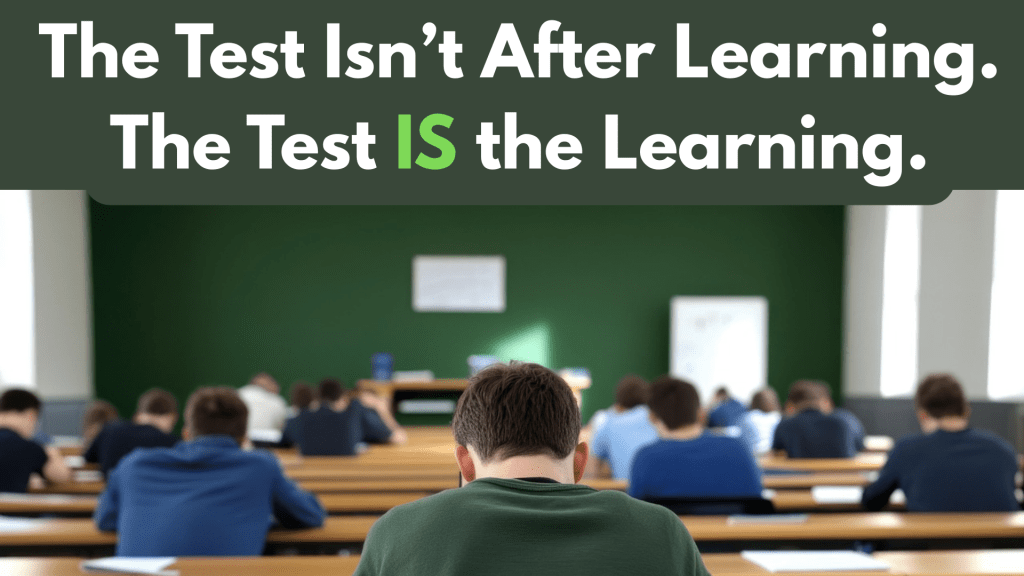
Testing is not the end-goal of learning. It’s learning itself.
See AI As Your Retrieval Practice Partner
So how do we implement this in practice?
For beginners, AI tools could be a great start. Instead of reading, use AI to generate personalized quizzes that test your understanding.
Studying a new concept? Ask AI to quiz you on it without looking back at your notes. Learning a programming language? Have AI present you with problems that force you to recall syntax and logic. Preparing for an exam? Generate mock questions that simulate test conditions.
Reading a long book? Put this on any GenAI tool (eg: Google NotebookLM) and ask it to test your understanding of the subject. In fact, the learning process can itself be gamified.
Use AI as a tool that creates retrieval opportunities. When AI asks you a question, resist the urge to immediately search for the answer. Struggle with it first. Only after attempting retrieval should you check your answer and learn from mistakes.
AI can also adapt to your knowledge gaps, focusing retrieval practice on areas where you’re weakest. It can create spaced repetition schedules, varying question formats, and providing immediate feedback.
All elements that enhance retrieval effectiveness.
From Theory to Practice: Project-Based Learning
This insight changes how we should approach skill acquisition. The fastest path to skill mastery is by applying skills for real projects.
Start with a project. Find an obstacle? Good. Now, research on solving that particular obstacle. Proceed. Repeat until completed.
This approach creates retrieval practice under optimal conditions. When you face a problem while building something, your mind is primed to remember the solution. You’re not absorbing information hoping it might be useful someday; you’re actively seeking answers to questions your work has generated.
Most people begin by watching tens of tutorials, aiming for first-time perfection. But without the struggle, the information doesn’t stick. They are forever in preparation mode, always “getting ready”.
First ship it. Put it out there in the public. Then, iterate.
Stop Consuming, Start Producing
Just as the modern workplace requires distinguishing productivity from pretend work, effective learning requires replacing ineffective techniques with demanding but ultimately rewarding ones.
Instead of attending unnecessary meetings, focus on deliverables that matter. Don’t watch another tutorial. Build something and learn what you need when you need it.
Don’t re-read notes, test yourself (better yet, have AI do this).
Like my UCAT experience showed: the time spent studying isn’t indicative of results. Mock tests beat review sessions. Building projects is better than watching tutorials. Active retrieval is more effective than passive consumption.
The appearance of work isn’t work. As a Telugu movie puts it, “Anybody can answer correctly in a classroom. The topper is the one who gets it right in the exam”.
 Musings by Madhav
Leave a comment