At a recent marketing event, a marketing leader summed up the current job market: “Only referrals seem to be opening doors for interviews these days. The rest disappear into the void.”
His observation got me thinking: why has the job market suddenly become this fortress where personal connections hold the keys?
The answer, I believe, lies in widespread penetration of AI in the recruitment process.
When Easy Became Too Easy
Remember when tailoring your resume to a job description actually meant something? You’d spend hours wrestling with how to re-orient every bit of your resume towards the job. That effort was a filter, for it separated those who truly wanted the role from those just carpet-bombing applications.
That struggle has vanished overnight.
Today’s AI-powered resume tools can churn out a perfectly optimized application in minutes. Upload your base resume, paste the job description, and eureka: you’ve a customized resume ready. What once required effort now gets done in a few clicks.
But here’s where it gets interesting: if everyone can easily optimize their resume, then an optimized resume stops being a meaningful signal.
The Signal-to-Noise Catastrophe
When writing was hard, it was a signal of effort. Now that AI generates volumes of content instantly, the new signal of care is brevity and authenticity.
The same principle applies to job applications. When customization required genuine investment, hiring managers could reasonably assume that tailored applications came from genuinely interested candidates. Today, that assumption no longer holds. A perfectly aligned resume might be the product of a few minutes with ChatGPT rather than three hours of thoughtful effort.
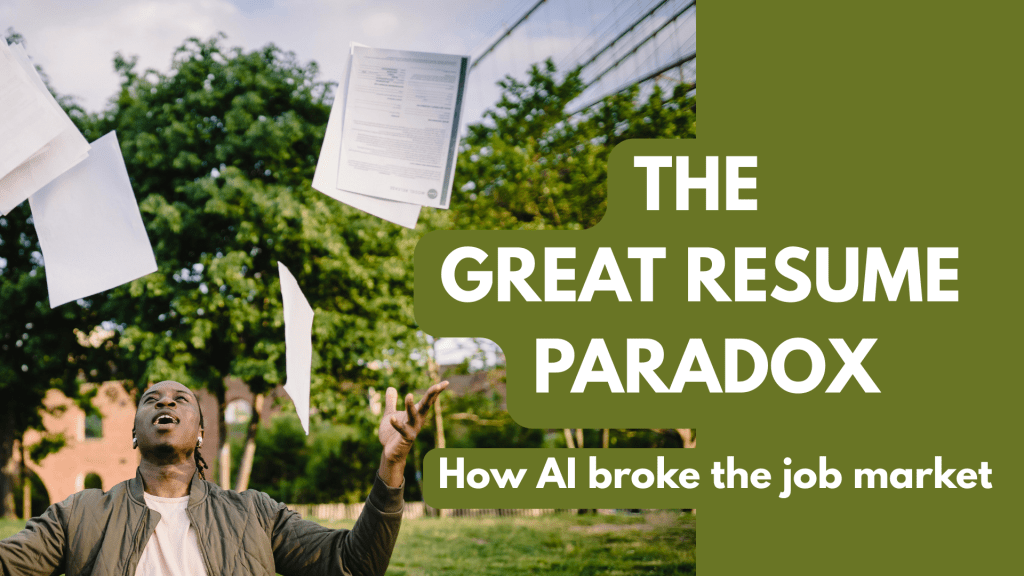
This creates what I call the Great Resume Paradox: the tools designed to help candidates stand out have made everyone identical. Hiring managers now face an unenviable task: distinguishing genuine resumes from genAI-resumes.
The Volume Problem Compounds Everything
The market dynamics turn an already challenging situation into a breakdown. With talent supply exceeding demand across many sectors, employers routinely receive 500+ applications for single mid-level positions. One tech company I know of saw their application volume triple after implementing “easy apply” options: from an already overwhelming 500 applications per posting to a crushing 1500.
To manage this deluge, HR teams are compelled to turn to AI too. Resume screening algorithms, keyword matching software, chatbot interviews, etc. Looks like most of the front end of hiring has been automated. Some companies now use AI avatars for initial screenings, with algorithms analyzing what candidates say, and how they say it.
Consider this hypothetical scenario: A mid-sized company implements an AI screening system that reduces their initial resume review time from 40 hours per week to 2 hours. Efficient, right? Except it also eliminated 60% of potentially qualified candidates who failed to use the exact keyword variations the algorithm prioritized.
We now have AI-generated applications being screened by AI systems. A feedback loop that nearly removes human judgment from the equation.
The Referral Returns
Faced with this digital chaos, hiring managers are reverting to trust-based networks. Referrals provide something no algorithm can replicate: accountability and context from a known source.
This explains the resurgence of “sifarish”, a staple in Hindi movies of the 1970s and 80s. It was quite a cliche in movies of that era: the protagonist is sidelined for another candidate who comes with a recommendation letter.
We’ve come full circle indeed. Today, personal endorsements matter more than ever before.
But this development comes with problems of its own. While referrals solve the signal-to-noise problem for employers, they create new inequities for job seekers. Over-reliance on referrals favors those with established networks, potentially excluding qualified candidates who lack the right connections.
The very platforms that promised equal opportunity are now driving us back to the old boys’ club. Probably with a better UX design.
When Digital Abundance Creates Human Scarcity
This phenomenon extends beyond hiring.
Online dating apps, which initially expanded choice and connection opportunities, now suffer from overcrowding. Today, people report greater success through in-person events and traditional social settings.
The job market is following the same trajectory. As Gartner predicts, by 2028, 70% of marketing budgets may pivot back to offline channels as a direct consequence of collective digital detox. When artificial output floods every channel, the premium on authentic, human-crafted interaction inevitably rises.
The Authenticity Premium
AI hasn’t eliminated the value of human effort in hiring. But it has changed what that effort looks like.
The new currency isn’t resume customization. It’s the ability to build genuine relationships, create social evidence, demonstrate authentic interest, and provide personal context. In an AI-saturated job market, human connections offer the ultimate advantage.
Perfecting LinkedIn profiles is just one part of the story. The significant part now is to have meaningful conversations at industry events. It’s about building relationships before you need them rather than scrambling for connections when unemployment strikes.
For those navigating today’s job market, the path ahead is complex.
You still need to work with the traditional systems like applying at job portals, etc.
Simultaneously, you need to build genuine professional connections. And this requires time, effort, and emotional intelligence.
The winners are those who understand that in a world of content overabundance, it’s human attention and trust that are more valuable.
In the end, we’ve arrived at a peculiar place: the most advanced hiring technology in history has made us more dependent on the oldest form of professional advancement—who you know.
Is this fair? No idea. But it’s here.
The question is whether you’re adapting to reality or still fighting yesterday’s game. Because while everyone else is perfecting their ATS optimization, the real opportunities are happening in conversations that no algorithm will see.
 Musings by Madhav
Leave a comment