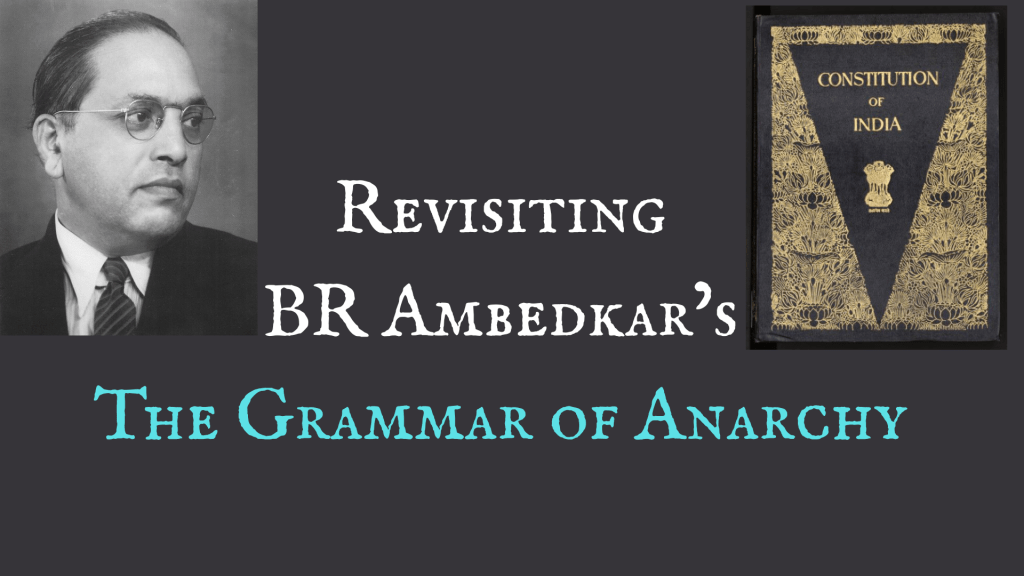
When I re-chanced upon Dr. B. R. Ambedkar’s “Grammar of Anarchy” recently, I was struck by its nuanced understanding of contemporary India (of 1949) and its prescient grasp of what could ail the Indian Republic in the future.
Dr. Ambedkar gave this speech on November 25, 1949, on the eve of the adoption of the Constitution of India. In fact, this was his final speech to the Constituent Assembly as the chairman of the Drafting Committee.
As we celebrate India’s 79th Independence Day, the speech remains relevant. We can take pride in having proved the doomsayers wrong, those who predicted India’s return to chaos. But we must also soberly note that the problems Ambedkar highlighted continue to challenge us today.
I strongly suggest you read the full speech in its entirety. On my part, I would like to discuss the insights that spoke to me most personally.
1. Abandon Unconstitutional Methods
There’s a tendency among today’s activists to equate those who derail India’s democratic processes with our freedom fighters of yore. But the comparison falls flat because today, we are governed by OUR constitution. Abiding by constitutional methods, even when tedious and patience-testing, is how we preserve the republic.
To quote Ambedkar: “When there was no way left for constitutional methods for achieving economic and social objectives, there was a great deal of justification for unconstitutional methods. But where constitutional methods are open, there can be no justification for these unconstitutional methods. These methods are nothing but the Grammar of Anarchy and the sooner they are abandoned, the better for us.”
This principle has been tested repeatedly, from the Emergency period to various agitations that have bypassed parliamentary processes. Each time, the temptation exists to justify extra-constitutional means for seemingly noble ends. Ambedkar’s warning reminds us that the method matters as much as the goal in a democracy.
2. Avoid Hero-worship
“Bhakti in religion may be a road to the salvation of the soul. But in politics, Bhakti or hero-worship is a sure road to degradation and to eventual dictatorship,” observes Ambedkar.
In India, this warning has proven prophetic. We’ve witnessed how regional strongmen, dynastic politicians, and charismatic leaders become immune to criticism within their constituencies. Corruption charges are deflected not with denials but with counter-accusations: “your leader was even worse.” Performance becomes secondary to loyalty, and policy debates give way to personality cults.
The phenomenon cuts across party lines and regions. Whether it’s the deification of political dynasties, the unquestioning support for caste-based leaders, or the elevation of any politician to near-mythical status, such hero-worship corrodes the very foundation of democratic accountability. Citizens stop asking hard questions, and leaders stop feeling compelled to provide answers.
3. Social Democracy is as Important as Political Democracy
Unlike Western democracies that arrived at universal franchise through gradual struggles and phases, India leaped to universal suffrage all at once in 1950. But the India of 1950 was among the world’s poorest democracies and a highly fragmented society with deep social fissures.
These contradictions didn’t escape our constitution’s framers. As Ambedkar remarked: “On the 26th of January 1950, we are going to enter into a life of contradictions. In politics we will have equality and in social and economic life we will have inequality. In politics we will be recognising the principle of one man one vote and one vote one value. In our social and economic life, we shall, by reason of our social and economic structure, continue to deny the principle of one man one value. How long shall we continue to live this life of contradictions?”
Seventy-four years later, these contradictions persist with uncomfortable clarity. We celebrate political equality while social hierarchies remain entrenched. Depressed classes may vote freely but still face discrimination in employment and social mobility. Women participate in elections but struggle against systemic gender bias. Economic inequality has widened even as political participation has deepened.
This tension manifests in electoral behavior too. Voters often support parties that promise social recognition or caste solidarity over those offering better governance. The political equality of the ballot box coexists uneasily with social inequalities that make some votes more consequential than others through concentrated influence and economic power.
4. The Constitution Is Open to Evolution
While the constitution must be respected, it’s not beyond change. When circumstances evolve, the constitution must evolve too, but only through the provisions it itself provides. This is the difference between systematic change and anarchy: the system transforms through internal, gradual evolution while maintaining continuity, not through external revolution.
India’s constitutional history illustrates both the promise and peril of this approach. We’ve seen beneficial amendments that expanded rights and representation, such as those that created reservation policies or lowered the voting age. But we’ve also witnessed controversial amendments during the Emergency that threatened democratic foundations, later reversed by subsequent governments.
Ambedkar quotes Thomas Jefferson in this context: “We may consider each generation as a distinct nation, with a right, by the will of the majority, to bind themselves, but none to bind the succeeding generation, more than the inhabitants of another country.”
This principle suggests that each generation must have the freedom to reshape institutions for contemporary needs. Yet it must be balanced against constitutional stability. The challenge lies in distinguishing between necessary evolution and opportunistic manipulation; a distinction that requires both political maturity and democratic vigilance.
The Enduring Relevance of Deep Thinking
These insights from Ambedkar’s speech connect to a broader concern about how we engage with foundational ideas in our fast-paced, summary-driven age. People often ask me: who reads long-form content anymore? Why labor through the full text of “The Grammar of Anarchy” when you can get an AI summary in seconds?
This question misunderstands what serious reading achieves. When you engage with Ambedkar’s complete argument, you witness not just his conclusions but his reasoning process. You see how he anticipated objections to the newly-framed constitution and crafted defenses against them. You feel the weight of expectations on the drafting committee and sense the enormous gravity of India’s decision to govern itself democratically from day one.
You encounter Ambedkar’s parting counsel in its full context: “But let us not forget that this independence has thrown on us great responsibilities. By independence, we have lost the excuse of blaming the British for anything going wrong. If hereafter things go wrong, we will have nobody to blame except ourselves.”
This depth, intellectual, political, and moral, cannot be grasped through shortcuts. It’s the difference between seeing an animal on your device and experiencing it live in its natural habitat: one gives you information, the other gives you understanding.
Constitutional democracy requires citizens who think deeply, not those who consume summaries. Ambedkar’s warnings about anarchy, hero-worship, and social contradictions demand the kind of sustained reflection that only comes from genuine engagement with serious ideas. In our age of quick takes and viral opinions, perhaps the most radical act is to slow down and think through the foundational questions that still shape our republic’s destiny.
 Musings by Madhav
Leave a comment