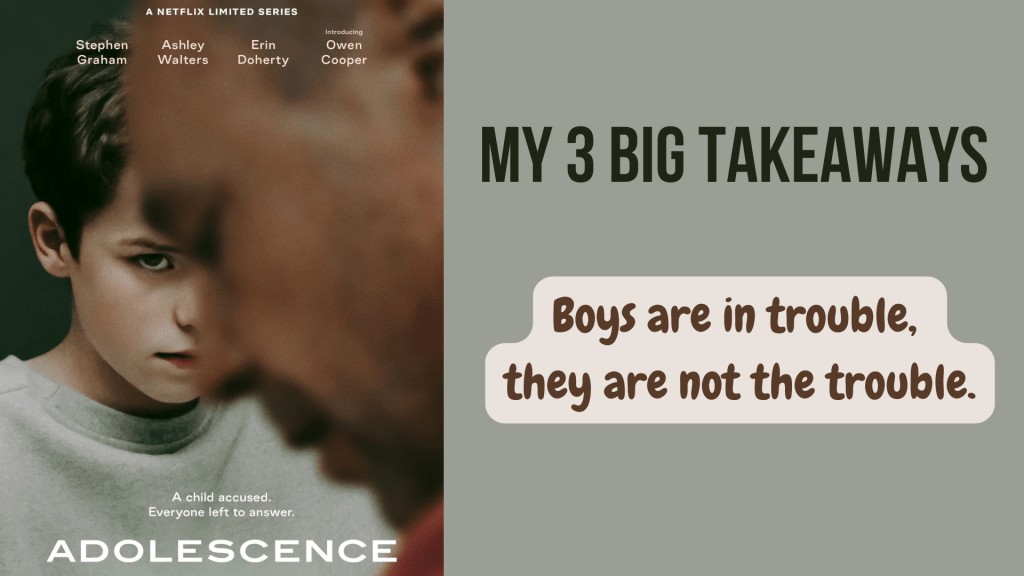
The Netflix series Adolescence has received both critical and mass acclaim across the globe.
The series is well-made and speaks about social issues that require our most urgent attention.
I can prattle along.
But, here, I wish to dive straight into my biggest takeaways from the series.
The Internet changed everything…
“The kids these days, I tell you. When we were your age, we….”
Isn’t this complaint an inter-generational occurrence? Parents calling out trouble-making kids, as opposed to how cool they were in their younger days. Knowing well the kids have no way to find out if things were really the way the parents claim.
But this is new. This is unprecedented. What today’s kids face is something far more insidious and dangerous.
For a while now, Jonathan Haidt, an American social psychologist, has been writing about the ill-effects of social media, especially on children.
His recent book The Anxious Generation argues how childhood underwent a “great rewiring” in the blink of an eye, between 2010 and 2015.
“The result was a new “phone-based childhood,” which altered the developmental pathways of children and adolescents, bringing them minimal benefits while reducing the time spent on beneficial real-world activities such as sleeping, playing with friends, talking with adults, reading books, focusing on one task at a time, or even just daydreaming.” [Source]
I still remember my joy as a kid who stumbled upon a new comic book of Chacha Chaudhary. The sorrow when my team lost in street cricket. During power cuts (a frequent occurrence those days), I used to just gaze at stars and locate the constellations we were taught at school.
None of this happens today. All you have are smartphones that give a pixelated view of everything you ask. Imagine a childhood with no use for imagination!
Adults don’t understand children’s world
A well-shot scene depicts how removed from social media reality the adults are. Based on their Instagram interactions, a detective presumes friendly relations between a girl and a boy at a school. Until his son (also a student at the same school) steps in and helpfully explains how he’s got it all wrong.
As this CNN article notes:
“The seemingly innocuous emojis that Katie commented with on Jamie’s Instagram were actually a coded form of bullying. The dynamite emoji represents an exploding red pill, a reference to the manosphere. The 100 symbol is another manosphere nod, alluding to a theory in those circles that 80% of women are attracted to 20% of men.”
“In other words, Katie implied that Jamie is an incel.”
Readers’ Note: ‘Incel’ is short for ‘involuntary celibate’; in this context, the girl is branding the boy unattractive, incapable of getting laid.
This is also why opinion-makers, north of 40 years, are ill-equipped to understand the ground situation. Their worldview comes from a world locked in the past. They see the present using lenses borrowed from the past; they get it all wrong as the student says.
Boys are in trouble, they are not the trouble
When girls were underperforming at school, the society noticed and took drastic measures to change the situation.
Today, when told that boys have been left behind, society has chosen to largely overlook it.
In this numbers-rich article, Richard V. Reeves and Ember Smith assert that boys are falling behind girls in nearly all stages of schooling. Yet, precious little is being done to understand why this is so, and how boys can be helped.
In this 10-min video byte, Scott Galloway explains how the deck is stacked against men.
In another article, Richard V. Reeves talks about the declining share of male teachers in the classroom.
“.. it is bad news for boys, who are less and less likely to have male role models in the classroom.”
Indeed, “the real danger here is that the very idea of education gets increasingly coded as female; which is every bit as bad as if it was the other way round.”
“The difference between 33% and 23% is not just 10 percentage points. It may well be the difference between a career that is seen as belonging largely to one gender.”
Yet, when they talk about their problems, boys are more likely to be told they are the problem.
This needs to change.
As Eric Mungai writes on LinkedIn, we need to care more about boys, because they will turn into men one day.
“We often turn a blind eye to how boys and men are faring in school or at work, but when these same boys grow up to pursue politics, their choices inevitably shape the world we all inhabit.”
“The notion that we can foster societal growth and development without actively engaging men in positive ways is nothing short of a miracle in waiting—a transformation of water into wine.”
—————————————–
PS: Scott Galloway has been vocal about the problems young men are facing. Check his newsletter and this 1h podcast on this subject.
 Musings by Madhav
Leave a comment