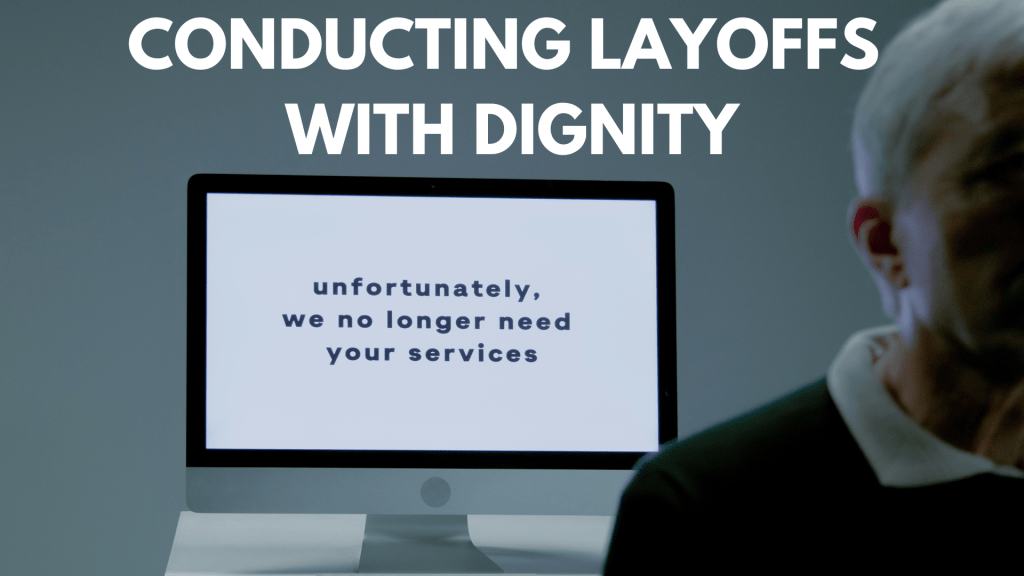
After a brief lull, it looks like it’s the layoffs season again.
Technicolor India closed its India operations, laying off over 2,500 people.
A news report says, “Employees were shocked when Technicolor India head Biren Ghosh in a town hall meeting told them that the company has reached a stage where they could not function as an organisation and that they do not have funds to send to Technicolor India.”
Expectedly, there’s confusion and chaos around.
The first time I had heard of a layoff happening over a Town Hall meeting was back in 2013. A friend’s agitated voice said: “We were called in for an impromptu town hall, and quietly informed that the company is shutting down its India operations. And, as a result, we are all to be laid off with immediate effect.” Here’s a media report on what happened at Gameloft.
Purely from a communications standpoint, I think a physical towns hall meeting is the last site to make such announcements. It’s too much of raw emotions at one place.
Even if it’s a digital town-hall, it’s no less difficult.
The counterview is that the company’s leader is making an effort to communicate the difficult news personally. That’s more humane than a surprise operation.
I agree. But, then, it still depends on how the process is planned and executed.
But I think such announcements are best made 1:1.
Some suggestions to consider.
Prepare the audience
“Prepare the audience”, that was a key lesson I learned from a famous Telugu movie scriptwriter. It’s as relevant in layoff communications.
Most layoffs are a direct result of financial performance. A few are caused by concerns of operational efficiency. These factors do not come to surface one fine day without a hint. They’re a long way in the making.
By appraising people of companies’ difficulties well before the D-day, you prepare them.
However, companies, understandably, may not prefer this tactic. Because, it’s tantamount to ceding control over the proceedings.
However, here’s one reason I think this should be considered. Because, the companies will be forced to do this, eventually, on the D-day.
“As you’re aware, the company is going through difficult times. We’ve been trying our best to navigate the situation. But, we’re left with no option but to…”
Anyone who’s ever been through a layoff can catch a whiff of what’s next at the very first line.
And, this kind of throat-clearing session is bound to look performative then. People will likely see this as a transparently obvious tactic to mellow the blow.
Do not overdo empathy
Back in 2021, Better’s CEO broke the layoff news in a Zoom call, saying: “It’s been a really really challenging decision to make and this is the second time in my career I’m doing this and I do not, do not want to do this. The last time I did this, I cried. This time I hope to be stronger.”
As I wrote in an article, the hushed and hurried manner in which the news was broken gives an impression of care being taken to minimize the unpleasant experience: of the CEO, not the people affected.
Taking this literally, in 2022, Braden Wallake, the CEO of social networking companies Hyper Social and Hyper Sphere, chose to append the layoff news with a pic of him crying.
The backlash was swift. As this op-ed notes: “Rather than being floored by how “vulnerable” Wallake had been, the consensus seemed to be that the guy was a tone-deaf narcissist.”
Why did such a ‘public display of empathy’ backfire?
Because, here, the conversation is being steered away from the people most affected by the decision: the laid off employees. Instead, the conversation is focused on the CEOs feelings. Imagine how their employees would have reacted to the same message sent via internal email.
Performative empathy can irk more people than a simple, stoic announcement. Also, such behavior is bound to be challenged in social media.
Make it fast
I literally suggested, “Prepare the audience”. How can I recommend the exact opposite now?
These suggestions belong to two different timelines.
The first is for days, or weeks, before the D-day. The second is during the D-day.
On the D-day, nothing can be more heart-pounding than a circuitous path to the news.
Gentle surgeons make stinking wounds. Think of what’s likely happening in the candidate’s mind. “Oh, they’re approaching the dreadful subject. Is there anything to salvage the situation? Could I miraculously avert the inevitable?”. Even those few minutes (which appear like eternity to the candidate) of false hope or dilemma is uncalled for when a decision, irreversible at that, has already been taken.
A better way is to dive straight to the point and clarify that the decision is beyond discussion. Though hurtful, the employees may not embarrass themselves any further by arguing their case.
The 3 components of layoff communication
Let’s conclude with a breakup of the layoff communication itself.
I think every layoff communication must address these three questions:
Why?
Why did it come to this? What happened that led the company to this juncture?
Significantly, what steps were taken to address the problems?
Tell the story that finally arrives at “layoff has been our last resort”.
What?
What’s the nature of the layoffs?
How many people are going to be affected? What departments are more likely to be affected?
What’s the business focus going forward?
How?
How will the story unfold now?
How will the organization support those on their way out. Example: outplacement service, severance pay, insurance, etc.
What about those to be retained? How does it assure them that they’ll not face the ax any more.
There’s no way to land the layoff news softly. But the sting of shock can be softened by offering dignity and empathy to those affected. Done well, the company may even manage to retain their long-term goodwill, despite the initial disappointment.
 Musings by Madhav
Leave a comment