Years ago, I finally met a writer I only knew by his works. His writing oozed satire, irreverence, and iconoclasm. His personality reflected warmth, kindness, and thoughtfulness.
The contrast between his writing and social self couldn’t have been sharper.
In his magnum opus, “The Story of Philosophy”, Will Durant chronicles the lives of philosophers alongside their work. He thought a glimpse into the philosophers’ life reveals the context that midwifed their works.
However, if you have watched enough artists from close quarters, you will probably arrive at the same conclusion as I did.
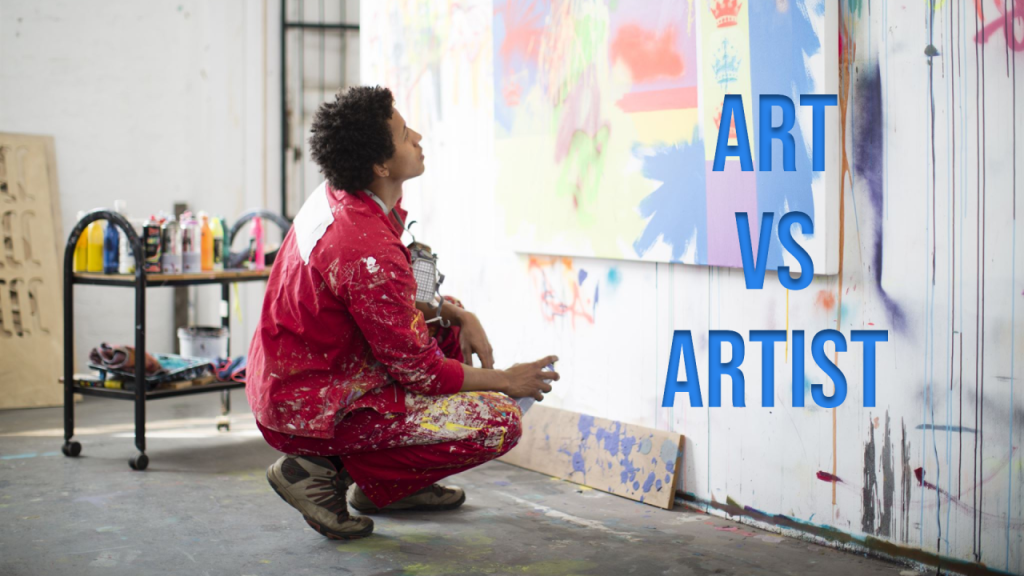
Artist as an artist ≠ Artist as a human being.
The forces that impel an artist towards creative excellence are different from the forces that shape his social self. His outwardly appearance and behavior are not inspired by the same forces that move his heart.
That’s why I think it’s futile to map an artist to his art through his lived experiences.
Sure, no man is an island. A person’s experiences (inputs) are bound to color his creative outputs. Yet, the link is not always a straight line. Because, the road from input to output passes through the black box of human consciousness.
Artist vs. Human
VS Naipaul, the celebrated writer, articulates the dichotomy with flourish in his Nobel Lecture (while accepting the 2001 Nobel Prize in Literature).
Naipaul starts: “The nineteenth-century French critic Sainte-Beuve believed that to understand a writer it was necessary to know as much as possible about the exterior man, the details of his life. It is a beguiling method, using the man to illuminate the work. It might seem unassailable.”
He then recalls how Marcel Proust was able to pick the argument apart.
“This method of Sainte-Beuve,” Proust writes, “ignores what a very slight degree of self-acquaintance teaches us: that a book is the product of a different self from the self we manifest in our habits, in our social life, in our vices. If we would try to understand that particular self, it is by searching our own bosoms, and trying to reconstruct it there, that we may arrive at it.”
Naipaul goes on to assert that even in an autobiography, a writer cannot reveal his complete self.
“All the details of the life and the quirks and the friendships can be laid out for us, but the mystery of the writing will remain. No amount of documentation, however fascinating, can take us there. The biography of a writer – or even the autobiography – will always have this incompleteness.”
Cancel Culture
Lately, there have been calls to cancel certain artists. Artists whose work doesn’t comply with the woke culture. Or, where the artist has been revealed to be a terrible human being.
As Arundhati Roy, the famous writer, concedes: “A lot of evil people make beautiful art.”
She goes on: “… not every piece of art should be judged based on the purity and morality of its creator.”
“We should be uncomfortable, morally outraged, and assess a work of art from a place of discomfort because art is not meant to be a moral guidebook,” she said.
Like Naipaul emphasized: there’s a difference between the writer as writer and the writer as a social being.
Artist’s intent vs. Viewer’s interpretation
When I watched “The Dark Knight” (2008 movie), I thought the movie was about the fine line between good and evil. About how it just required a push to turn a good man towards evil.
But according to the director Chritaphoer Nolan, the movie’s dominant theme was escalation. The movie starts with Batman pushing the criminals too hard. To Batman’s dismay, the criminals turn to Joker, who unleashes chaos Gotham never saw before.
When filmmaker Ramgopal Varma met the veteran director Govind Nahalani, Varma spoke about his favorite from Nahalani’s works, ‘Ardh Satya’. Varma liked how the movie depicted the scenes in and around the police station. To Varma’s surprise however, Nahalani made the movie for the father-son relationship.
Arundhati Roy has also suggested that, “an author does not “own” a book; the audience is free to consume and interpret it in their own ways.”
No matter what the artist’s intent, it’s the viewer who refracts meaning from the art using his own prism.
As this article notes: “The one who views the art is ultimately the one who interprets it. No matter what intentions an artist has when making their art, there is no guarantee that each individual viewer will come away from the art with the intended impression. You may make a painting about a solitary tree in a landscape, intending to depict the persistence of nature, while I may see it as a representation of loneliness. Even when trying to gauge the artist’s own intentions and emotions, you may still see what you want to see.”
Conclusion
Albert Einstein was not exactly an ideal husband. Yet, his contributions to science made our world a better place. Imagine a radical group wanting to ‘cancel’ Einstein because of his conduct in personal life.
Likewise, when people speak of ‘canceling’ artists for their politically incorrect views, they are missing the forest for the trees. The artistic self and the social self are two different beings trapped in the same body.
To paraphrase German philosopher Arthur Schopenhaeur, an artist creates art, “with the same sort of necessity as a tree brings forth fruit, and demands of the world no more than a soil on which the individual can flourish.”
The artist can be subjected to the rules of the society; but art deserves to be celebrated as a standalone.
 Musings by Madhav
Leave a comment