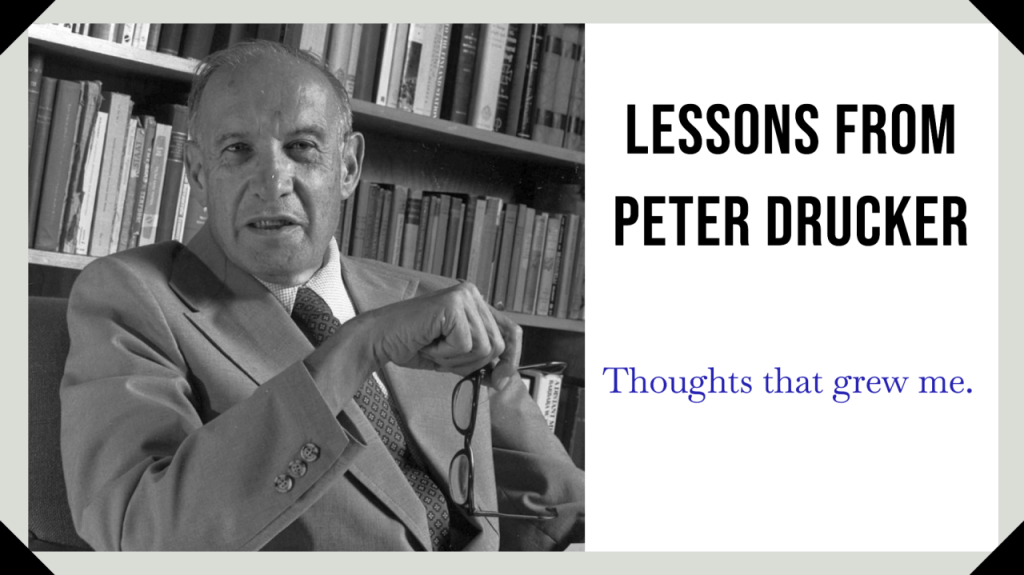
Most thinkers’ work spans thousands of pages. Yet, to my mind, their entire work can be condensed into 3-5 big ideas. The soil-type that nourished their oeuvre can be pinned down with accuracy.
I plan to occasionally post about “What I Learned” from my favorite thinkers. These are the big 3 (or more) ideas that most resonated with me. Obviously, your takeaways from the same thinker could be different. Let me know your picks from these thinkers in the Comments section.
Let’s get started with Peter Drucker, the popular management guru.
Idea #1: Are you a reader or listener?
Peter Drucker asserts that you primarily learn either by reading or by listening. While people do learn both ways, each person has only one dominant type.
And the consequences of not knowing your type can be damaging.
Drucker picks up the former US President Dwight Eisenhower to buttress his argument. Earlier, as a Commander-in-Chief of Allied Forces in Europe, his press conferences were reportedly a treat to watch. He was reputed to be an eloquent orator with the ability to elegantly explain the wartime situation. Yet, a decade later as the President of the USA, he was ridiculed for rambling incoherent responses to the questions asked by the media and rarely sticking to the point.
Why?
Drucker posits that this happened because Eisenhower didn’t know that he was a reader, and not a listener. As a General, he had prior access to the questions to be asked in the press conferences. This afforded him the time to prepare the masterful responses that earned him much admiration. In contrast, as the President, he inherited a system that was tailored for listeners. The previous Presidents, Franklin D Roosevelt and Harry Truman were not just listeners but also recognized themselves as such. They had everything read out loud to them. Eisenhower followed the system already in place due to which the questions by journalists didn’t register with him. All leading to harsh criticism.
Understanding how you learn is the most critical element of your self-awareness. Knowing it and acting on this information can help you punch your full weight in your career.
More examples:
- Most writers learn, not by reading and listening, but by writing. Since schools do not allow this mode of learning, many writers do poorly at school.
- Examples abound of business leaders who talked at their team (not talked to) because talking out aloud to an audience is how they learn.
- Beethoven used an enormous number of sketchbooks to write his compositions. Just that he never actually referred to them again. When asked, he responded writing is how he remembered his compositions.
Idea #2: Improving your strengths is easier than overcoming your weaknesses
When looking at self-improvement, we often focus on areas we are found wanting.
But it’s vital to differentiate between areas where we’re abysmally incompetent and areas where we are reasonably good.
Because, according to him, “It takes far more energy and work to improve from incompetence to mediocrity than it takes to improve from first-rate performance to excellence.”
Therefore, it pays to amp up on areas we’re already good at. In the knowledge economy, this helps build your brand (that “identifies” and “differentiates” you from the rest).
The efforts to push our skills from the incompetent zone to the mediocre zone are largely wasted. Because, even if you do succeed in it, there are still plenty of people who can do it better than you.
Create a place that confers you strength. And place yourself where your strengths work for you.
Idea # 3: Saying no is the biggest productivity hack
Drucker gave the productivity hack of all time: “There is nothing so useless as doing efficiently that which should not be done at all.”
In our productivity-obsessed times, we think we can elastically squeeze in as many tasks as we wish. When we fail, we attribute it to our techniques or motivation levels. But time management tips like timers, timeboxing, power naps, and re-ordering our schedules, etc. can only take us so far.
Because, the elephant in the room is: we only have so many hours a day. We can only do a certain amount of work each day.
By saying yes to every task, we are adversely affecting each task’s outcomes. As Ryan Holiday remarks: “Whenever you say “yes” to something, you’re saying “no” to something else.”
We can be good at anything, not everything.
So, it’s up to us to choose the areas we wish to focus on. And, ruthlessly eliminate tasks that don’t contribute to our goals. Let’s remember: in life, there are no solutions, only trade-offs.
 Musings by Madhav
Leave a comment