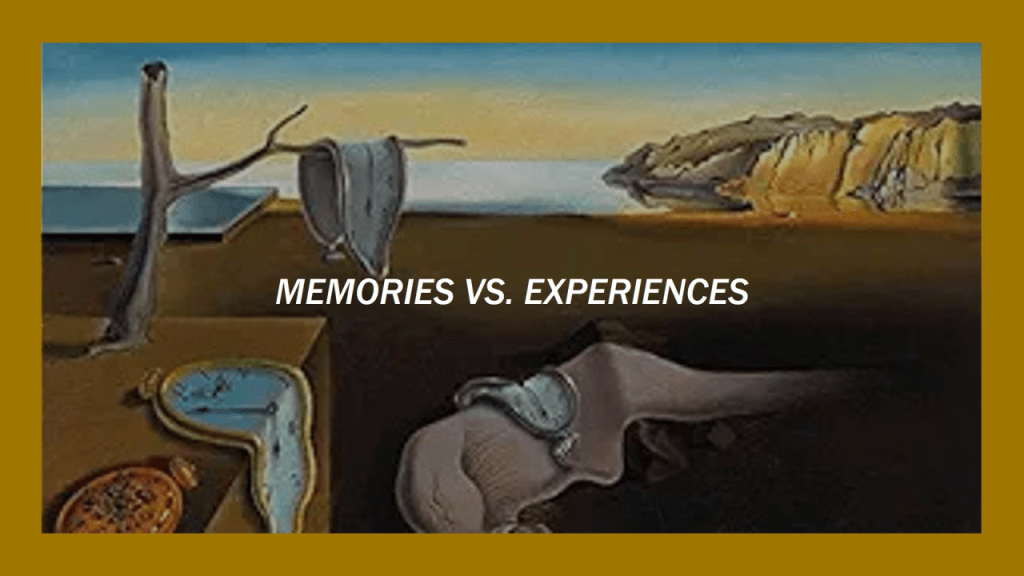
What’s it about the college days that evokes joy?
As I contemplated, it hit me: at the time of college, the experiences weren’t nearly as rosy. Today, they appear beautiful simply because I see them with a nostalgic lens.
I’m sure, you may have experienced this too. Some memories that you paint with a golden hue today were unarguably painful at the time you were experiencing them.
Did I stumble upon a unique strand of thought? That’s when I recalled Sherlock Holmes’: “Read it up – you really should. There is nothing new under the sun. It has all been done before.”
Daniel Kahneman, the famous cognitive scientist who passed away recently, had not just touched upon this topic at a TED Talk, but explored it at length.
Here’s the TED Talk that I strongly suggest to you:
According to Kahneman, we have two selves: the ‘experiencing self’ and the ‘remembering self’.
The experiencing self is only concerned with the present moment. As Kahneman helpfully explains, it’s this self that a doctor addresses when he taps a body part and asks, “Does it hurt?”
However, when you ask someone how their recent trip was, your question is being answered by their ‘remembering self’. Because they are not on the trip at the moment of asking. This self, the one that digs into memories and responds, is a storyteller. It makes a sense of these memories in a fashion that can be radically different from how you really experienced it.
Imagine two people, A and B, who are at station Z of their life.
- A covered a long distance to reach station-Z.
- B, in contrast, has been hovering around station-Z for most of his life.
Who, according to you, is more likely to report higher levels of happiness?
The ‘Remembering Self’ creates it’s own world
It’s a truism that most adults revel in. That the times were better when they were young.
The times were great in your youth, not because the times were great, but because you were young.
This is also why most people, regardless of their current age, tend to gravitate towards songs, movies, etc. that trended during their youth. It’s not that great movies were confined to one timeline that coincidentally overlapped with their youth. It’s just we stopped paying attention since.
In Kahneman’s words: “We don’t choose between experiences, we choose between memories of experiences. Even when we think about the future, we don’t think of our future normally as experiences. We think of our future as anticipated memories.”
Imagine you need to choose between an exotic and a familiar tourist destination. That’s a no-brainer, right?
Let’s put just one condition: you cannot take pictures at the exotic location, and you’re not allowed Instagram. Let’s suppose you can do them both at the other, familiar location.
Now, which one would you pick?
Let’s take it further. Imagine your memory of the tourist experiences will be erased at the journey’s end.
See how the prospect of creating future memories impacts our decisions?
Closing Notes
Another theory of mine (that I hope someone somewhere has already deep-dived into) is that memory becomes strong by virtue of its association with other memories.
A big-impact event tends to be forgotten if it’s one, isolated occurrence with no links to other memories. However, events that we registered as low-key at the time of happening are invested with new significance if you can connect the dots to something memorable in the present.
We rarely have an objective view of the past. In fact, a lot of how we see a certain event is controlled by how we think it panned out in the present. An unpleasant event that is seen to have ended well is seldom characterized as “unpleasant”. Likewise, a failed end-result can erase the memory of an excellent start.
The past is not carved in stone. It’s what we make of it.
Be that as it may, Daniel Kahneman deserves our appreciation for clarifying what many of us intuitively gasp at, but fall short of grasping.
This distinction is critical in understanding human behavior as it relates to personal and business life, politics and public policy.
 Musings by Madhav
Leave a comment