
“Change” is a magic word, whether in organizations or societies.
Newly appointed business or political leaders often deride the existing systems and promise to ‘transform’ the way businesses/societies operate.
Who would be satisfied with the status quo?
Who wouldn’t want to walk into a brighter future promised by the change?
Decimal time and French Republican Calendar
In 1779, the French revolution overthrew the monarchy. But the revolutionaries weren’t satisfied with putting the royal family and the elite to the guillotine.
They wanted to cut ties with the religious past in every possible way. In an experiment unmatched in its ambition, the revolutionaries decided to create a new scientific system of calendar and time.
For ages, the sexagesimal system of measuring time was in vogue (one day = 24 hours; 1 hour = 60 minutes; 1 minute = 60 seconds). The traditional calendar was Gregorian too (12 months).
These relics of the ancient regime, the revolutionaries thought, were an affront to the newly formed Republic. They had to be erased to make way for the rational, scientific way of life established by the Republic.
Fueled by reformatory zeal, a new decimal time was made official in 1793. In the new system:
- 1 week = 10 days
- 1 day = 10 hours
- 1 hour = 100 minutes
- 1 minute = 100 seconds
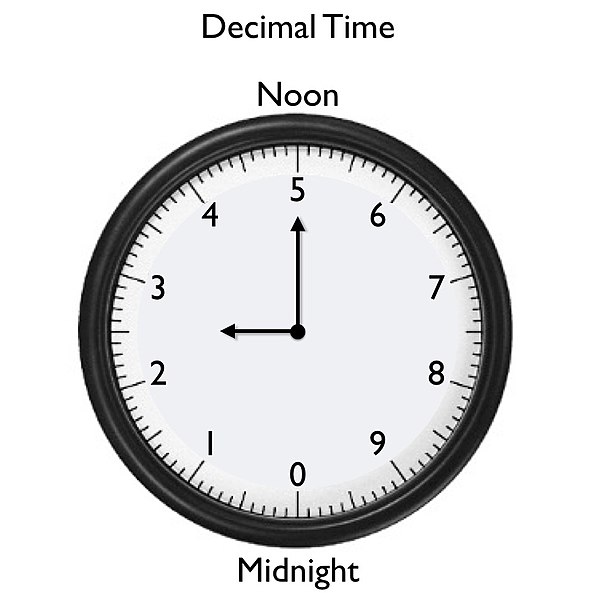
Here’s how a Decimal Clock looks (source):
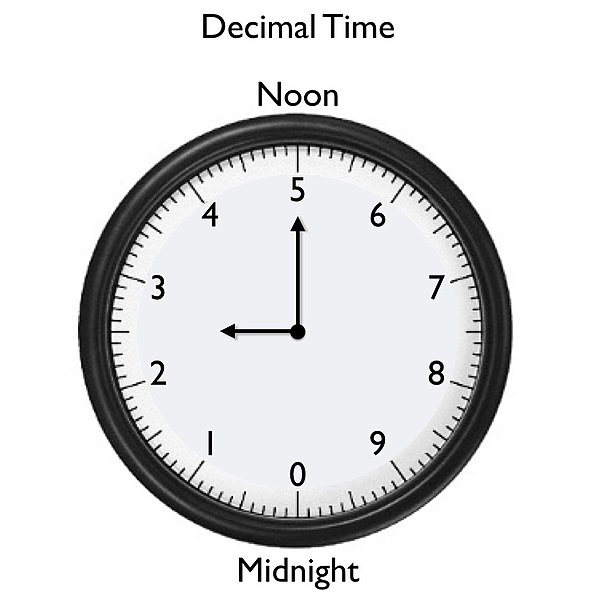
As you can see, the midnight starts at 0:00 and the mid-day occurs at 5:00.
The idea was to make it difficult for the society to identify the holy days (Sundays for church and other festivals). The idea was to erase what the society held as sacred.
Even the new year started not on January 1st but on September 22 (the founding day of the French Republic).
For all the fanfare with which the new system was launched, it was withdrawn in 1805 by Napoleon Bonaparte, who ironically made himself the ‘Emperor’. This rise of the First French Empire was the sad endpoint of the French Revolution that killed the royal family and the elite in the pursuit of “Liberty, Equality, Fraternity”.
Back to our story, why was the decimal time withdrawn?
Briefly, it made communication with the rest of the world difficult. How can you plan to meet someone on a particular date when you both have a different conception of time?
As a result, even trade activities were slowed by the need to navigate an alien system.
Above all, even the people were greatly inconvenienced by the new system. They got a holiday after every 9 days, rather than 6 days. Therefore a lot of time (pun unintended) and efforts were expended in creating special clocks that translated the decimal time to the traditional time.
A functioning system was uprooted to mark the dawn of the new (Republican) era. Pity that the dawn lasted for mere 12 years.
The tradition quietly reclaimed the lost ground.
Can’t Make Omelet Without Breaking Eggs
Maximilien Robespierre, one of the highly influential figures of the French Revolution, once justified the terror and chaos it wreaked with : “One can’t expect to make an omelet without breaking eggs.”
Except that socialists (or statists if you’ll) like him failed to make an omelet despite breaking an extraordinary number of eggs.
History is full of people who think they can change the world for good if only society realigns themselves according to their vision. Which is why the common excuse for failed revolutions is: the people were too selfish to sacrifice their self-interest at the altar of the common good.
The Test of Time
While all societies must be receptive to change, the reforms must be introduced with caution.
As Edmund Burke wrote:
“The science of government is so practical in itself” that it required “even more experience than any person can gain in his whole life.” He continued: “It is with infinite caution that any man ought to venture upon pulling down an edifice which has answered in any tolerable degree for ages the common purposes of society, or on building it up again without having models and patterns of approved utility before his eyes.”
Change, indeed, may be necessary in certain circumstances.
In such circumstances, it’s worthwhile to emulate India’s former Prime Minister PV Narasimha Rao’s style. Rao disguised change as continuity to push reforms that were seen as a radical departure from India’s socialist leanings.
Conclusion
Any system that has stood the test of time has prevailed for a reason. It prevailed because it met the needs of a significant chunk of the stakeholders, whether of society or an organization.
In the business context, before we embark on a “transformation” initiative, let’s understand why the current system has prevailed for so long. What would be the second and third-order effects of upending the current system. What additional measures are required to soften the blow of such effects?
Incremental growth has none of the glamor that ‘transformation’ has. But, sometimes, incremental steps are probably the answer to your problems. Especially since they won’t be nearly as risky as radical change.
 Musings by Madhav
Leave a comment