A picture is worth a thousand words, the saying goes.
But I believe that some words are worth a thousand pictures.
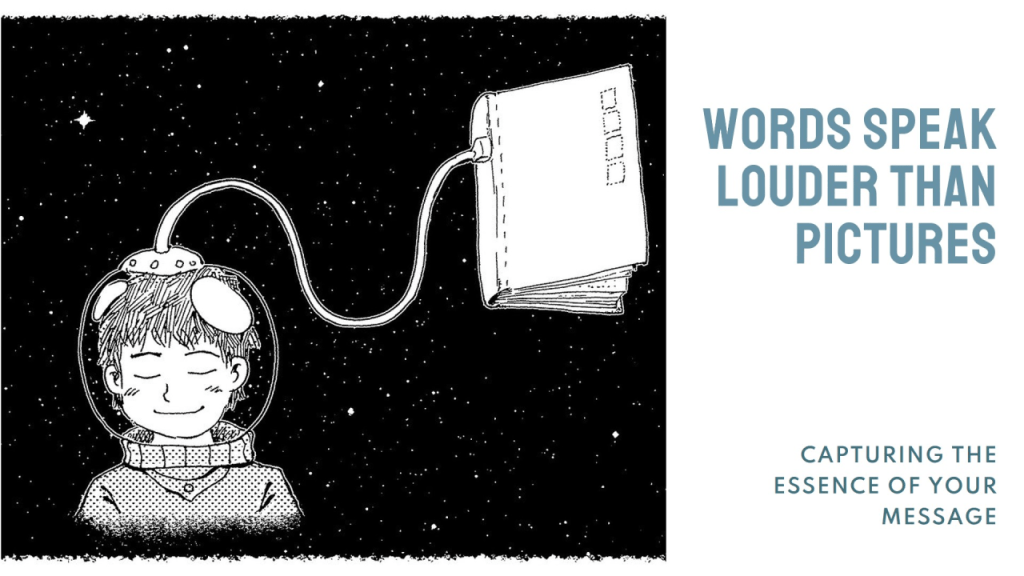
Thanks to the digital revolution, the audio-visual mediums of communication are now mainstream. Explainer videos are the new newspaper columns. Podcasts are the new blog.
Their popularity proves that they are catering to the needs of a major demography. Indeed, Peter Drucker, in Managing Oneself, posits that some people learn by listening. Of course, they can learn by reading too, but listening comes more naturally to them.
However, a byproduct of this audio-visual dominance is the unwarranted undermining of writing as a medium.
I have seen many instances where a pictorial or video representation of a concept can simplify and clarify complex things.
However, I also think some instances lend themselves better to a written form.
Back in my engineering days, on a night when sleep proved elusive, I finally gave up and looked for distraction. As luck would have it, my room-mate had left a copy of The Complete Sherlock Holmes at our table even as he was conveniently away.
So engrossed was I with the book that I knew not when the day broke. I quote just one of the many places I loved: the confrontation between Sherlock Holmes and Professor Moriarty.
[Prof. Moriarty]: “It has been a duel between you and me, Mr. Holmes. You hope to place me in the dock. I tell you that I will never stand in the dock. You hope to beat me. I tell you that you will never beat me. If you are clever enough to bring destruction upon me, rest assured that I shall do as much to you.’
[Sherlock]: “You have paid me several compliments, Mr. Moriarty,’ said I. ‘Let me pay you one in return when I say that if I were assured of the former eventuality I would, in the interests of the public, cheerfully accept the latter.”
I conjured up a vivid image of this verbal duel. The lead up to this scene is excellent too, right from how Moriarty is introduced as the “Napoleon of crime”.
But I found the cinematic representation of this very episode in “Sherlock Holmes: A Game Of Shadows” to be disappointing (though this could have stemmed from my deep reading of the Sacred 𝖢̶𝖺̶𝗇̶𝗈̶𝗇̶ Conan).
Sample this excerpt from Desmond Bagley’s Running Blind:
“I was standing at the edge of the cliff road with a body at my feet. You didn’t need to study medicine to know how the man died. He died of cardiac arrest. The arrest was caused due to a thin blade of steel passing through his heart. I wasn’t too anxious to call a doctor as at the time the blade pricked out his life its handle happened to be in my hands.”
The last line makes you jump with a shock. Do you think a video format could make you feel that way?
The Godfather is a rare movie that matched the intensity of the novel it was based on. Yet, in a few places, the novel shines. Look at how it describes Michael Corleone’s exile in Italy.
“After five months of exile in Sicily, Michael Corleone came finally to understand his father’s character and his destiny. He came to understand man like Luca Brasi, the ruthless caporegime Clemenza, his mother’s resignation and acceptance of her role. For in Sicily he saw what they would had been if they had chosen not to struggle against their fate.”
Nothing in the movie prepares you for Michael’s dark turn ahead like this does. In these few lines, Mario Puzo vividly captures the hardening of Michael’s heart like the movie never does.
Advanced CGI has made making historical movies a lot easier. We have reached a point where we’re literally transported to the world that existed hundreds, or even thousands of years ago. Yet, for the story to fit into the cinematic template, the nuances have to be overlooked.
Sometimes, the cinematic representation of a written form may well be impossible.
Consider this quote from Freedom At Midnight (by Dominique Lapierre & Larry Collins).
“In August 1947, a mirage of prosperity concealed the reality of Calcutta. The lush green sweep of the Maidan, the Georgian mansions and offices of its great trading companies along Chowringhee, were only a surface veneer, a facade as false as a cinema set.”
Behind them, through awful mile after awful mile, stretched a human sewer packed with the densest concentration of human beings on the face of the earth. It included 400,000 beggars and unemployables, 40,000 lepers. The slums they inhabited were a foetid, stinking horror. Their streets were cluttered lanes lined with open sewers overflowing with their burden of garbage, urine, and excrement, each nourishing its hordes of rats, cockroaches, its buzzing clouds of flies and mosquitoes. The water flowing from their rare pumps was usually polluted by the corpses decomposing in the Hooghly from which it was drawn. Once a week, down those lanes, the pitiless zamindars stalked in search of the rent for each corner in hell.”
“At the moment when India was about to attain her freedom, 3 million human beings in Calcutta lived in a state of chronic under-nourishment, existing on a daily caloric intake inferior to that given the inmates of Hitler’s death camps.”
There’s a reason why reading is encouraged, especially for the young. It affords readers a unique opportunity to imagine what they are reading, instead of spoon-feeding their curiosity.
Today, ChatGPT is being hailed as a replacement for humans. It will replace writing of course: but of the generic kind. The kind of writing that makes our mind feel and our heart think can only come from a human.
When we give in to AI anxiety, we are guilty of underestimating our greatest strength: our imagination, our creativity, our curiosity, and our humanity.
 Musings by Madhav
Leave a comment