In the early 1990s, the modern nation-state of India found itself in dire conditions. Four decades of socialist governance brought the nation to the cusp of economic collapse, separatist movements threatened the democracy, India’s supporter in the world-stage (USSR) was at the brink of breakdown, and the nation just lost its charismatic leader in suicide bomb.
Just when it appeared all hope was lost, destiny intervened and brought a scholar-politician on the verge of retirement back to the corridors of power – to the country’s top job.
Vinay Sitapati’s “Half Lion – How PV Narasimha Rao Transformed India” chronicles the life of the modern-day Chanakya, PV Narasimha Rao. It aims to answer the central puzzle of how Rao managed to achieve so much despite having so little power.
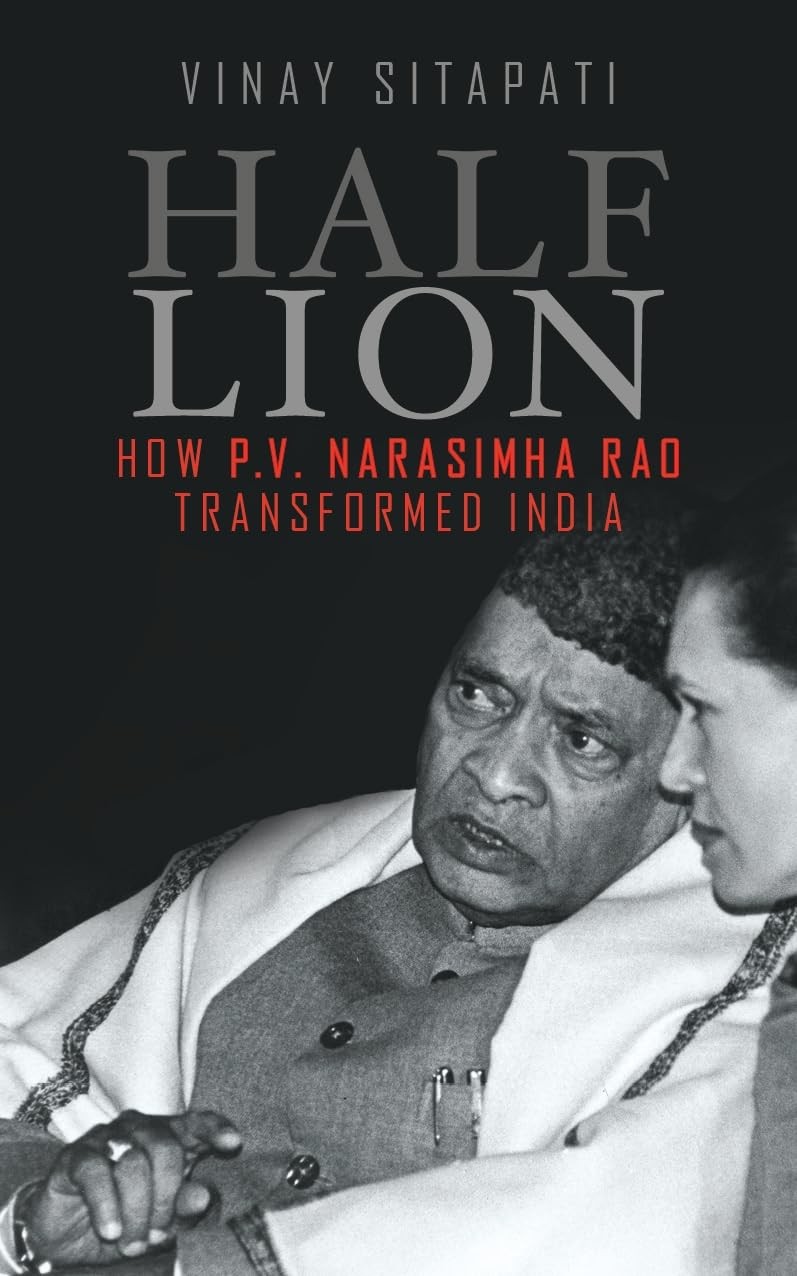
The making of the master
When PV Narasimha Rao became the ninth Prime Minister of India, he inherited not just a system sliding into abyss, but also one of the weakest political mandates. While he was tasked with unprecedented challenges, he didn’t have the required floor strength to push through the reforms that were considered politically risky. So how did Rao walk on the razor’s edge, simultaneously managing opposition and pacifying rivals within the party to transform India and put it on the highway to rapid growth?
As with Winston Churchill, Rao’s “past life had been but a preparation for this hour and for this trial”. Vinay traces the beginnings of Rao in present-day Telangana, and how his early tribulations shaped his future persona. By his tenth year, he experienced adoption, separation, and marriage, and the ensuing loneliness later became the defining theme of his entire life.
In his brief stint as Chief Minister of Andhra Pradesh, he pushed land reforms with vigor, earning the ire of partymen who found their entrenched interests affected. A naïve plain-speak about his resolve to follow the Supreme Court order to restore Mulki rules provided the excuse to bring him down. Thus, his brief experience as CM gave him the much-needed bitter dose of pragmatism.
Rao, the Prime Minister, would later deftly outmaneuver reform-opponents by disguising change as continuity and bewilder them through calculated silence.
This is a man who once said: “When I don’t make a decision, it’s not that I don’t think about it, I think about it and make a decision not to make a decision.” And that “Inaction is also action”.
The time of reckoning
The untimely death of Rajiv Gandhi forced warring groups within Congress to zero in upon Rao as the compromise candidate. Rao, halfway in his journey to head a Hindu monastery, was asked to return. In a series of swift moves, Rao cornered other political heavyweights and secured his position. An eight-page note prepared by the bureaucracy on the economic collapse staring India on its face changed Rao from protectionist to a reformer. The transformation was so complete that Rao, later, spoke like a businessman in foreign countries and sought to attract investments, in a sharp departure from previous PMs.
Vinay insists that Rao already understood what had to be done, and wanted a credible face as the Finance Minister to send a positive signal to the West. Had IG Patel, Rao’s first choice for the post of FM, assumed office, the reforms would have been more or less similar (he declined the post). But without Rao’s political backing, the liberalization process simply stood no chance.
India hit its lowest ebb soon when it became clear that its foreign exchange reserves would barely last two weeks and the government was close to default. The Rao government had to mortgage national gold reserves to the Bank of England to buy time.
Things turned, and thankfully, this time for the better.
Lasting legacy
Vinay goes into many details of how Rao successfully pulled India back from the brink. These are the juiciest parts of the book.
But ideological leanings aside, what Rao achieved is staggering, considering his weak political mandate and constant intra-party quibbles.

Strong diplomatic relations with Israel, telecom revolution, the exponential growth of satellite TV channels, nuclear policy, political stability, consistent foreign policy among many others.

This is a transformational change on the scale achieved by the likes of Deng Xiaoping of China, Ronald Reagan of the United States, and Margaret Thatcher of Great Britain.
 Musings by Madhav
Leave a comment